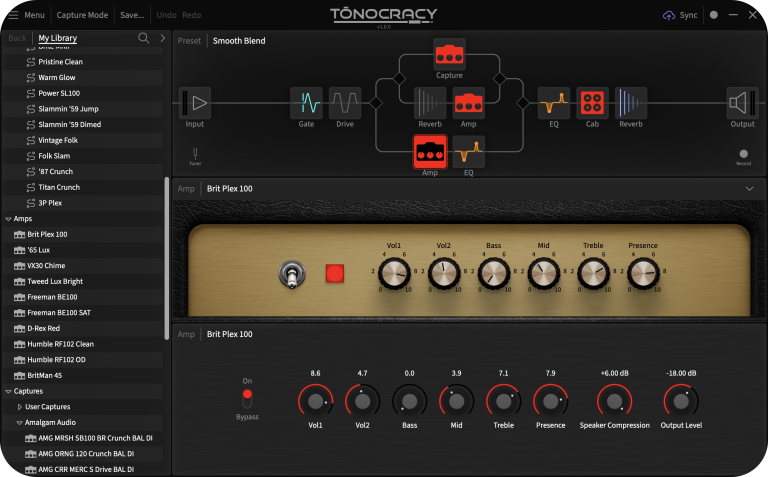
Tonocracy is Atomic Amplifiers’ most ambitious release to date, combining cutting-edge amp modelling, AI-powered gear capture, and a growing ecosystem of effects into a single plugin and standalone app.
Now available for free, it’s designed as a long-term tone platform rather than a closed product, bringing together modern modelling, cloud processing, and community-driven content in one streamlined environment.
At the core of Tonocracy is ToneSnap, Atomic’s proprietary gear snapshot technology. Using AI-driven analysis, ToneSnap captures the sonic DNA of real amps, cabs, and pedals, converting them into portable, playable snapshots.
The capture process is deliberately simple and hardware-agnostic, with built-in calibration tools that eliminate common gain-staging issues found in other profiling systems.
All ToneSnap processing happens in the cloud on Atomic’s GPU servers, meaning no heavy CPU load, no manual file handling, and no need for a high-end graphics card. Once complete, snapshots are instantly available in your personal library or can be shared with the wider community.
Alongside ToneSnap, Tonocracy features SchemAccurate modelling, a hybrid approach that blends component-level modelling with AI techniques.
This aims to deliver not only accurate tone but also authentic control behavior, with knobs and switches responding like their real-world counterparts.
Tonocracy’s collection includes 16 documented SchemAccurate amp models, inspired by legendary hardware from Marshall, Fender, EVH, Mesa Boogie, and more. I’ve broken down every model and its original hardware inspiration in my complete Tonocracy amp list, including three additional models missing from Atomic’s main catalogue.
SchemAccurate models and ToneSnap captures coexist within the same signal chain, giving you multiple ways to build and refine tones.
Tonocracy also embraces the wider modelling community by natively supporting Neural Amp Modeler.
NAM models can be loaded directly, allowing users to combine community-created captures with Tonocracy’s amps, effects, and routing. This makes Tonocracy an interesting bridge between proprietary and open-source amplifier modelling.
But how does Tonocracy actually compare with NAM as a standalone plugin? In my Tonocracy vs NAM comparison, I explore the differences in modelling technology, effects, workflow and compatibility, including which option makes more sense given Tonocracy’s registration problems.
To complete the signal chain, Tonocracy includes custom impulse responses created in partnership with ML Sound Lab.
These cabs are designed to be immediately mix-ready, complementing both SchemAccurate models and ToneSnap captures with clarity and balance.
A suite of built-in effects rounds out the platform, all presented in a modern, performance-focused interface.
Unfortunately, Tonocracy’s registration and cloud-service problems could make these features difficult for new users to access. If you’re looking for similar amp modelling, cabinet processing, and effects without relying on Tonocracy, I’ve researched the 6 best Tonocracy alternatives, including free options with NAM support and flexible signal routing.
A future-facing guitar tone platform built for flexibility and realism.
No. ToneSnap processing is handled in the cloud, keeping local system requirements low.
Yes. Tonocracy fully supports Neural Amp Modeler files alongside its own technology.
No. It’s designed as an open platform, combining Atomic models, community snapshots, and NAM content.
Yes. Tonocracy is now available at no cost.