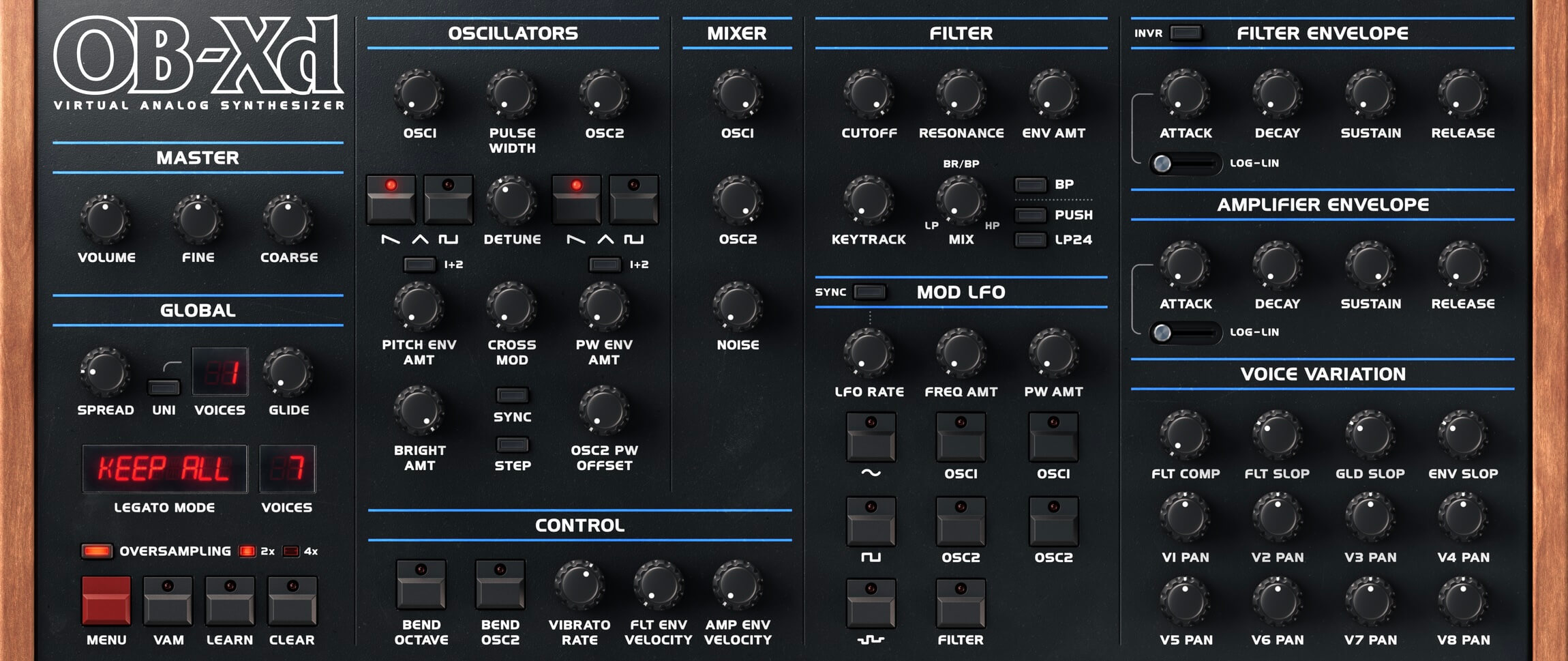
OB-Xd 3 revives the unmistakable sound of the Oberheim OB-X and pushes it firmly into modern production territory. Faithful in tone yet expanded in scope, it delivers huge polyphonic pads, aggressive unison leads, and classic analog warmth with impressive efficiency.
Whether you are chasing vintage character or contemporary supersaw density, OB-Xd 3 balances authenticity with modern performance and workflow upgrades.
At its core, OB-Xd 3 stays true to the character that made the original OB-X legendary.
The oscillators and filters are designed to reproduce that wide, full-bodied analog sound, from warm basses to shimmering pads and biting leads. The multimode filter smoothly transitions from bright, open highs to deep low-end weight, and at high resonance levels, it can self-oscillate for intense, expressive sweeps.
What sets OB-Xd 3 apart is how far it extends this foundation. You can stack up to 16 voices per note in unison mode, creating massive textures without sacrificing clarity or running into voice-stealing issues.
Envelope shaping ranges from slow, evolving movements to tight, punchy attacks, making the synth equally comfortable in lush chord work or aggressive rhythmic roles.
Under the hood, OB-Xd 3 features a completely rewritten audio engine built around modern SIMD processing, delivering exceptional CPU efficiency on both Intel and Apple Silicon systems.
Advanced anti-aliasing makes oversampling optional rather than mandatory, preserving high audio quality even at standard sample rates. For those who want maximum fidelity, the registered version unlocks up to 4x oversampling.
Workflow improvements are equally significant. A powerful preset browser lets you search across your entire library instantly, while bi-directional MIDI support allows deep integration with hardware controllers.
Micro-tuning via MTS-ESP opens the door to alternative tuning systems, and subtle per-voice variations in Analog Mode recreate the organic inconsistencies of vintage hardware. Importantly, OB-Xd remains effect-free by design, giving you a pure synth signal ready to be shaped with your own processing chain.
A modern reimagining of the OB-X sound with expanded polyphony, performance, and control.
OB-Xd 3 models the discrete signal path and behaviour of the original OB-X architecture rather than relying on simple waveform playback. The oscillators, filter response, and envelope behaviour are carefully recreated to emulate the organic drift and harmonic richness associated with vintage Oberheim polysynths.
At the same time, the engine is optimised for modern CPUs, allowing dense polyphony and stacked voices without the heavy processing overhead often found in detailed analogue emulations.
Voice stacking allows multiple synth voices to trigger simultaneously from a single key press, dramatically increasing perceived width and density. By slightly detuning or modulating each stacked voice, producers can create huge pads, supersaw-style leads, and evolving textures that would otherwise require multiple layered instances.
The plugin reproduces the OB-X’s classic multimode filter response with particular attention to resonance behaviour and nonlinearities present in analogue circuitry. The filter interacts dynamically with oscillator levels and envelope modulation, producing the signature punchy bass and sweeping pads associated with Oberheim hardware.
Unlike many vintage polysynth emulations limited to the original hardware’s voice count, OB-Xd 3 supports expanded polyphony so complex chords and sustained layers can play without prematurely cutting off notes. This is particularly valuable for cinematic pads or stacked chord progressions where multiple voices and long release tails would normally exceed hardware limits.
OB-Xd excels in genres that rely on wide, harmonically rich polysynth textures. Its architecture makes it especially effective for lush pads, vintage-style basslines, and bright detuned leads commonly heard in synthwave, house, techno, and modern electronic music.