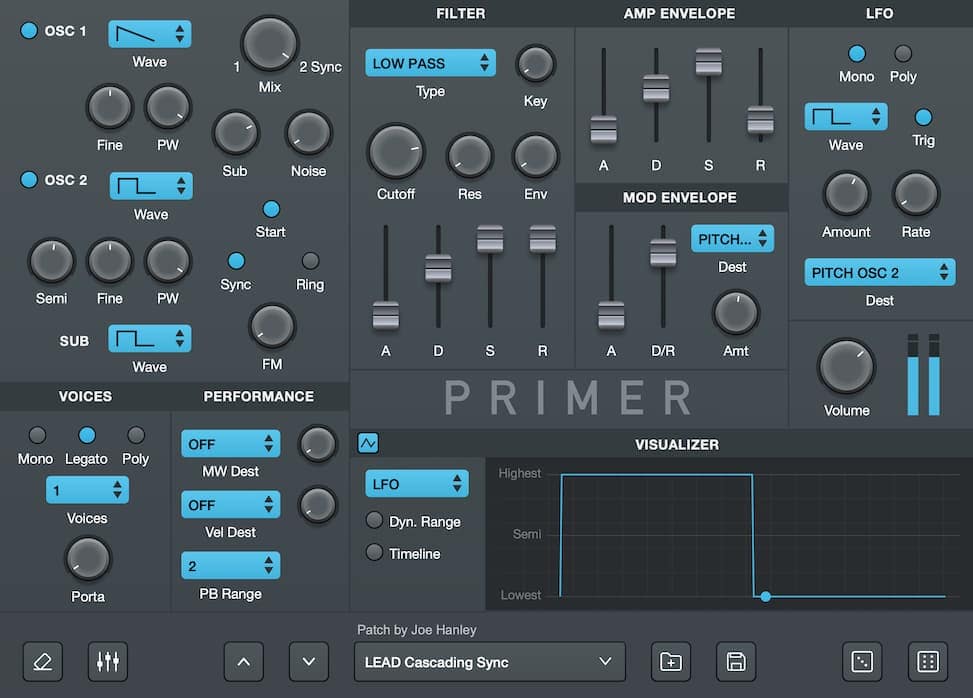
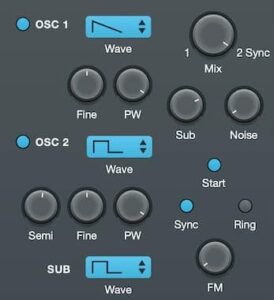
Primer 2 is built around a three-oscillator subtractive architecture. Two main oscillators feature waveform selection, pitch control, pulse width modulation and level blending. A dedicated sub oscillator reinforces the low end, making it easy to build weighty bass patches or fuller leads.
You get the classic analogue waveforms: saw, pulse, triangle and sine. There’s oscillator sync for aggressive harmonics, a noise generator for texture, and an FM control for adding metallic or edgy character without diving into complex routing.
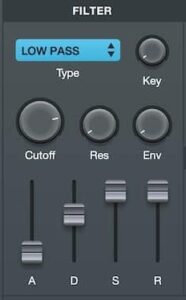
The filter section offers low-pass, band-pass and high-pass modes, complete with resonance and key tracking. It’s paired with a dedicated ADSR filter envelope, plus a separate amp envelope and an additional AD modulation envelope. This keeps modulation straightforward but flexible.
For movement, there’s an LFO with four waveform shapes and seven assignable destinations. It can run in mono or poly mode and offers trigger options for different playing styles. Add portamento, mono, legato and poly voice modes, and you’ve got a surprisingly adaptable instrument.
Primer 2 introduced a modernised, fully resizable interface. It’s clean and scalable, making it comfortable on both laptop screens and large studio monitors. The update also added one of its most useful features: the Visualizer.
The Visualizer displays envelope shapes, filter behaviour and LFO modulation in real time. This is invaluable for beginners trying to understand what attack, decay or modulation depth actually does. Even experienced producers benefit from seeing modulation visually when fine-tuning movement.
Another standout addition is the Randomizer. There are two patch generation modes, each capable of producing usable sounds rather than chaotic noise. It’s an effective way to spark ideas quickly or explore territory you might not normally program manually.
Despite being designed as a learning synth, Primer 2 includes a full effects section. You get distortion, chorus, phaser, delay and reverb, making it easy to shape complete sounds without reaching for external plugins.
Unison is also included, with voice count, detune and stereo spread controls. This allows you to create thick supersaw-style leads, wide pads or stacked basses. Ring modulation is available for more experimental textures, and velocity, mod wheel and pitch wheel assignments make patches performance-ready.
The overall sound character is clean and modern. It doesn’t try to emulate vintage hardware imperfections, but instead delivers a stable, consistent digital tone that sits well in contemporary mixes.