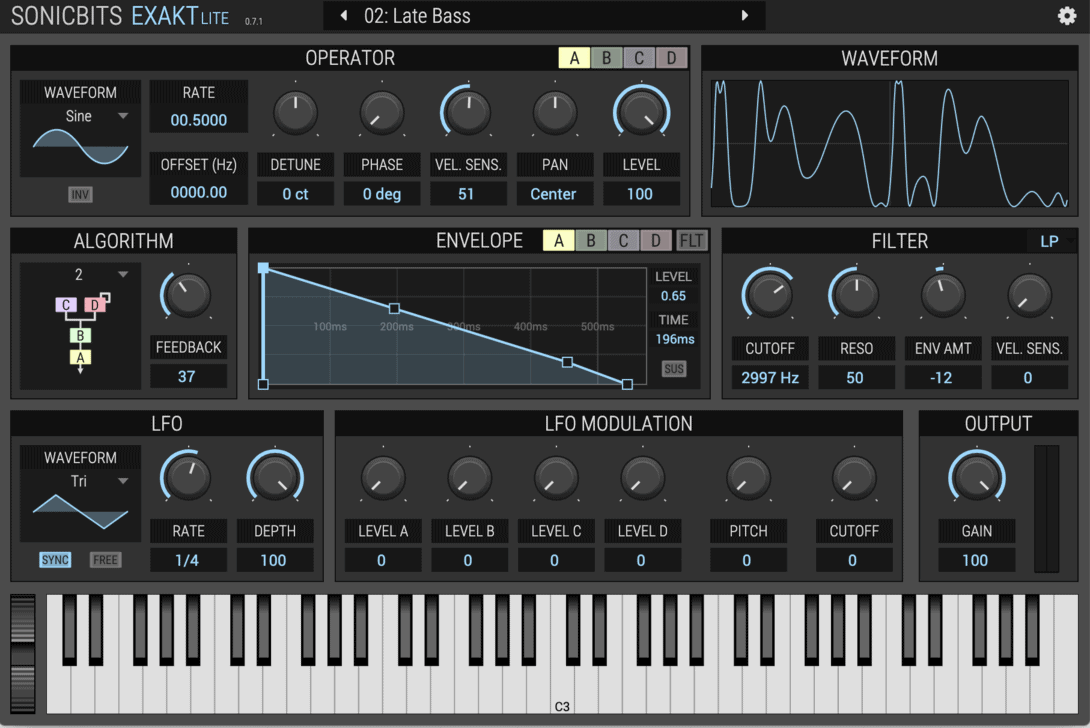
Exakt Lite is an FM synthesizer that strips away the usual confusion and replaces it with clarity, feedback, and musical intent.
Built around classic 4-operator FM architecture, it captures the unmistakable digital character of early FM hardware while adding a modern workflow that actually encourages experimentation.
Whether you’re chasing glassy 80s keys, metallic basses, or warmer evolving tones that don’t scream “FM preset,” Exakt Lite makes frequency modulation feel playable rather than punishing.
At the heart of Exakt Lite are four alias-free operators arranged across eight classic FM algorithms, complete with feedback on operator D. Each operator offers a broad waveform palette, from standard shapes to the instantly recognisable TX81Z waveforms, giving you access to both clean and gritty FM flavours.
The colour-coded layout makes it obvious which operators are carriers and modulators, so you spend less time decoding signal flow and more time shaping sound.
A standout feature is the real-time waveform display, which updates instantly as you tweak ratios, levels, or algorithms. This visual feedback removes a lot of the guesswork FM is famous for and lets you dial in tones with far more precision.
Add in drag-and-drop TX-style envelopes, a resonant multimode filter, and a lush chorus, and Exakt Lite becomes equally suited to sharp percussive sounds and smooth, musical textures.
Exakt Lite keeps modulation powerful but focused. A flexible modulation matrix allows routing from an LFO or dedicated modulation envelope to up to 17 destinations, covering operators, pitch, and filter parameters.
Envelope shapes can be copied between operators, edited visually, and set to sustain or run freely, making complex motion easy to manage. The vector-based interface scales cleanly at any size, keeping everything readable even during deep sessions.
Yes. The operator structure, envelopes, and TX81Z waveforms are designed specifically for authentic vintage FM tones.
It works well beyond retro. The filter, modulation matrix, and chorus make it easy to design contemporary basses, pads, and experimental textures.
Absolutely. Seeing how modulation affects the waveform in real time makes dialing in FM sounds far more controlled and predictable.
While streamlined, the modulation matrix is flexible enough for evolving and expressive patches without becoming overwhelming.
Yes. The visual feedback, colour-coded operators, and drag-and-drop envelopes make it one of the more approachable FM synths available.