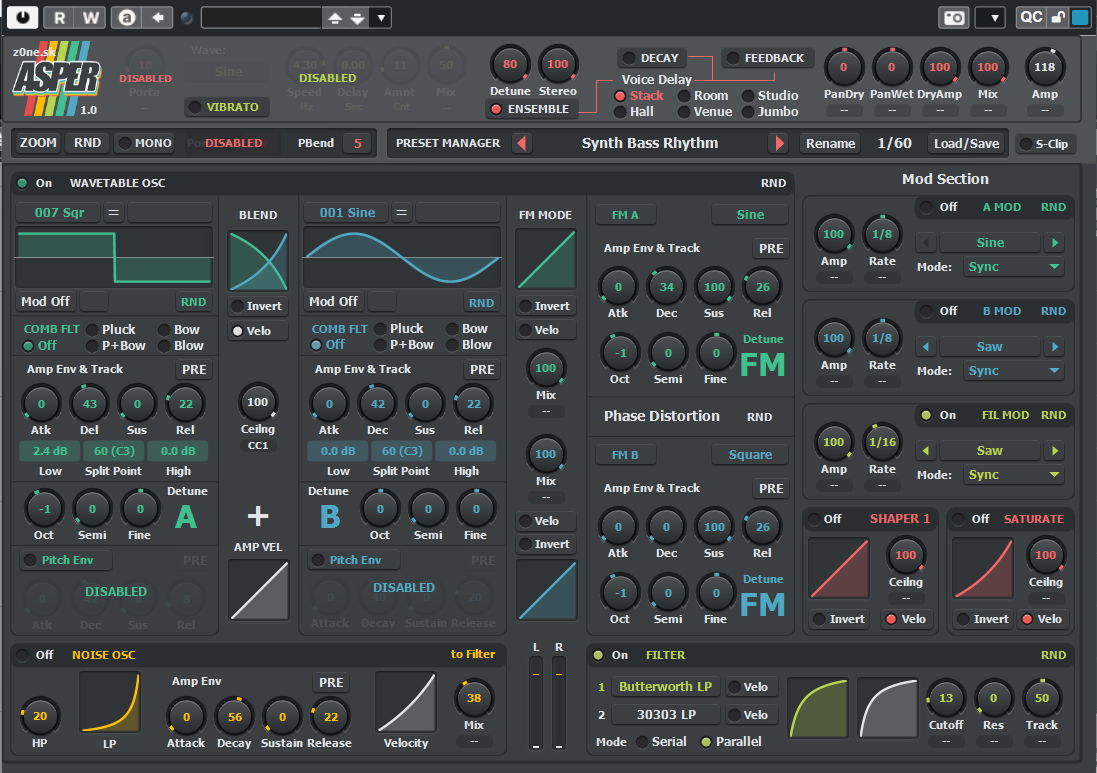
Asper is a free experimental synthesizer built around a single idea: making digital sound feel less static. Instead of chasing classic analog behaviour, it focuses on round-robin style variation at the oscillator level, introducing subtle inconsistencies that make every note feel slightly different.
The result is a synth that excels at organic, evolving textures, expressive leads, unstable basses, and modern electronic sound design that avoids the usual “perfectly repeated” digital feel.
Designed exclusively for Windows, Asper blends wavetable synthesis with subtractive shaping, phase distortion, physical modelling concepts, and noise generation.
It is clearly aimed at producers who enjoy hands-on exploration and controlled chaos rather than deep modulation matrices or traditional synth workflows.
At the core of Asper is a single wavetable oscillator split into two independent layers. Each layer can load any of the 118 included wavetables and has its own detune, phase distortion, comb filtering, pitch envelope, and amplitude shaping.
Instead of routing modulation sources, you shape behaviour directly at the oscillator level, making it easy to dial in expressive velocity-based movement without complex assignments.
Round-robin simulation is applied directly to both wavetable layers and the noise oscillator. This introduces subtle variations in phase, timing, and tone between hits, mimicking the behaviour of real instruments where no two strikes are identical.
It is especially effective for plucks, percussive sounds, and evolving pads that need to feel alive rather than looped.
Asper’s filter section can operate in serial or parallel modes, with additional modulation controls for cutoff behaviour and response shape.
Morphing, FM depth, and filter movement can all be shaped from exponential to logarithmic curves, giving precise control over how sounds react to velocity or MIDI CC input.
Beyond filtering, Asper includes saturation, dual-mode shaping, a vibrato module, ensemble processing for unison or reverb-like spread, and a simple soft clipper to prevent unwanted distortion.
Almost every section includes its own randomisation options, encouraging experimentation while keeping results usable. The interface is fully interactive, with mouse-over feedback and scalable GUI options from 80% to 150%.
Asper is built for expressive, modern sound design with an emphasis on movement and variation rather than traditional modulation routing.
Instead of relying on LFOs and envelopes for movement, Asper builds variation directly into the oscillator using round-robin style behaviour.
Yes, especially for basses that need weight without phasing issues. The independent fundamental handling prevents low-end beating while keeping upper harmonics lively.
No, by design. Asper replaces deep modulation matrices with layered oscillator control and response shaping for faster, more intuitive sound design.
It works particularly well for experimental electronic music, techno, drum and bass, ambient, cinematic textures, and modern hybrid sound design.
Despite its depth, Asper is reasonably efficient. CPU usage scales mainly with ensemble processing and filter configuration rather than oscillator count.