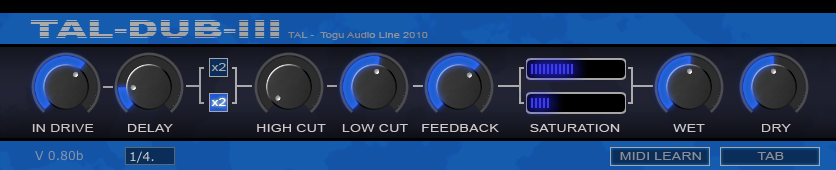
TAL-Dub III by Togu Audio Line is a clean yet characterful delay plugin that’s earned cult status for its warmth, musical feedback behaviour, and straightforward design.
It isn’t a tape delay emulation, instead, it has a sound entirely its own. Combining an alias-free saturation stage with flexible filtering and hands-on controls, it’s a perfect balance of precision and grit for producers who like their echoes with attitude.
At the heart of TAL-Dub III lies its signature saturation circuit, capable of pushing signals into subtle drive or full-on analog-style crunch.
The input drive control lets you dial in the perfect amount of colour, giving percussive elements a bit of punch or turning synths into gritty, swirling textures.
This saturation stage is alias-free, meaning you can crank it without introducing harsh digital artefacts, a rare feat for a free plugin.
The built-in low-pass and high-pass filters (6dB and 3dB respectively) shape the feedback tone inside the delay path.
This internal filtering is key to its warm, musical feedback loop, perfect for crafting dub-style tails, evolving textures, or filtered delay sweeps that blend naturally with your mix.
Despite its analog-style depth, TAL-Dub III’s interface is refreshingly minimal.
The plugin’s pop-up menus display precise values for delay time, feedback, and volume, giving users detailed visual feedback.
The Tap button is ideal for syncing delay time on the fly, making it a solid choice for live performance as well as studio use.
Whether used for subtle width or rhythmic echoes, TAL-Dub III stays CPU-light and predictable — letting you push delay feedback and saturation without crashes or crackles.
It’s simple, effective, and endlessly usable across genres.
Compact, musical, and built to deliver creative delay textures.
It uses an alias-free soft clipping algorithm that adds harmonic warmth and compression without digital distortion, even at high input drive levels.
Yes — pushing the feedback control past moderate levels will drive the circuit into controlled self-oscillation, great for dub or ambient soundscapes.
Both filters are placed directly in the feedback path, meaning each repeat becomes progressively filtered, creating smoother, more natural decay over time.
Delay time is continuously variable, allowing for smooth, sweeping changes and pitch-shift effects when automated or modulated live.