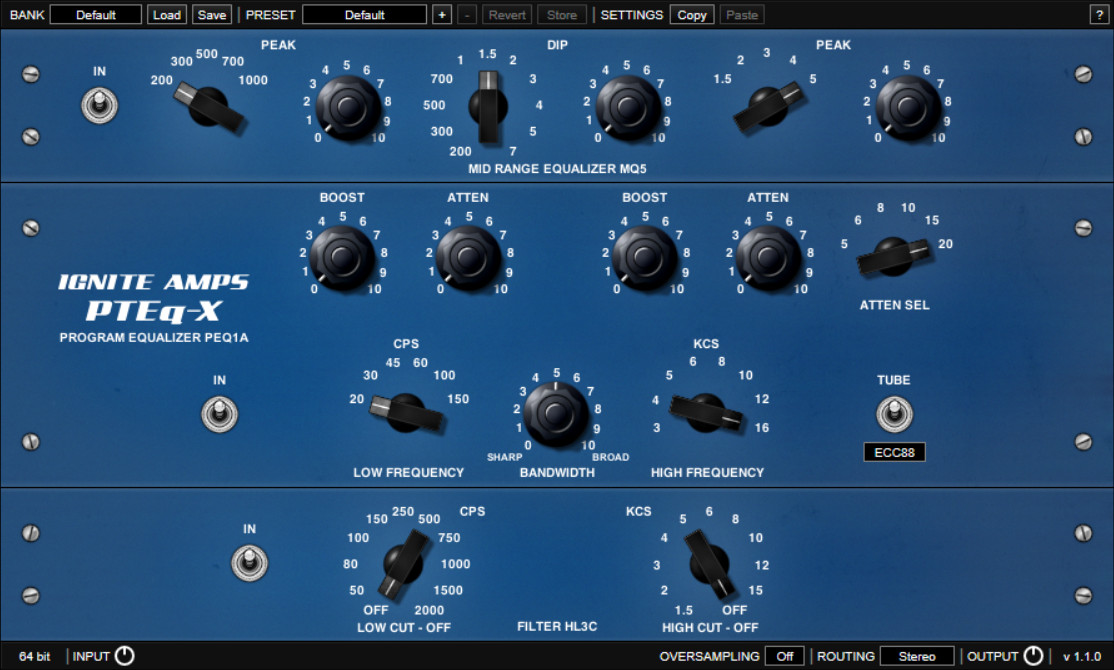
PTEq-X is a digital emulation of three classic passive program equalisers, designed to deliver authentic analogue tone inside a modern DAW workflow.
Built as a studio-grade EQ for tracking, mixing, and mastering, it focuses on recreating the behaviour, curves, and harmonic character of vintage hardware while adding practical improvements for flexibility, CPU efficiency, and real-time use.
PTEq-X includes three distinct equalisation modules, each modelled to preserve the original analogue frequency curves, even at extreme high-end boosts.
Every component in the original signal path has been carefully recreated, resulting in smooth, musical boosts and cuts that avoid the brittle edge often found in digital EQs.
Compared to the original hardware designs, PTEq-X adds extended frequency options for the PEQ1A-style module and improved frequency accuracy for the MQ5 and HL3C models. These refinements retain the musical intent of the originals while making the EQ more usable in modern production contexts.
Beyond EQ curves, PTEq-X models a third-generation triode tube stage with four selectable tube types, allowing subtle harmonic enhancement or more noticeable analogue colour.
Both the EQ modules and tube stage can be independently bypassed to manage CPU load or keep processing transparent when needed.
Optional linear-phase oversampling helps reduce aliasing during more aggressive settings, while 64-bit floating-point processing ensures accuracy across all gain stages.
Mono and stereo operation, global input/output controls, and full automation support make PTEq-X comfortable on individual tracks, buses, or mastering chains.
A faithful passive EQ recreation with modern studio control.
Passive EQs use broad, interactive curves that shape tone musically rather than surgically, making them ideal for colour, presence, and overall balance.
Yes. Its smooth curves, optional oversampling, and precise gain staging make it well suited for mastering and mix bus use when subtlety is required.
At low settings it adds gentle harmonic density. Pushed harder, it introduces more obvious analogue colour without collapsing clarity.
Oversampling reduces aliasing when boosting high frequencies or driving the tube stage, keeping the sound cleaner at extreme settings.