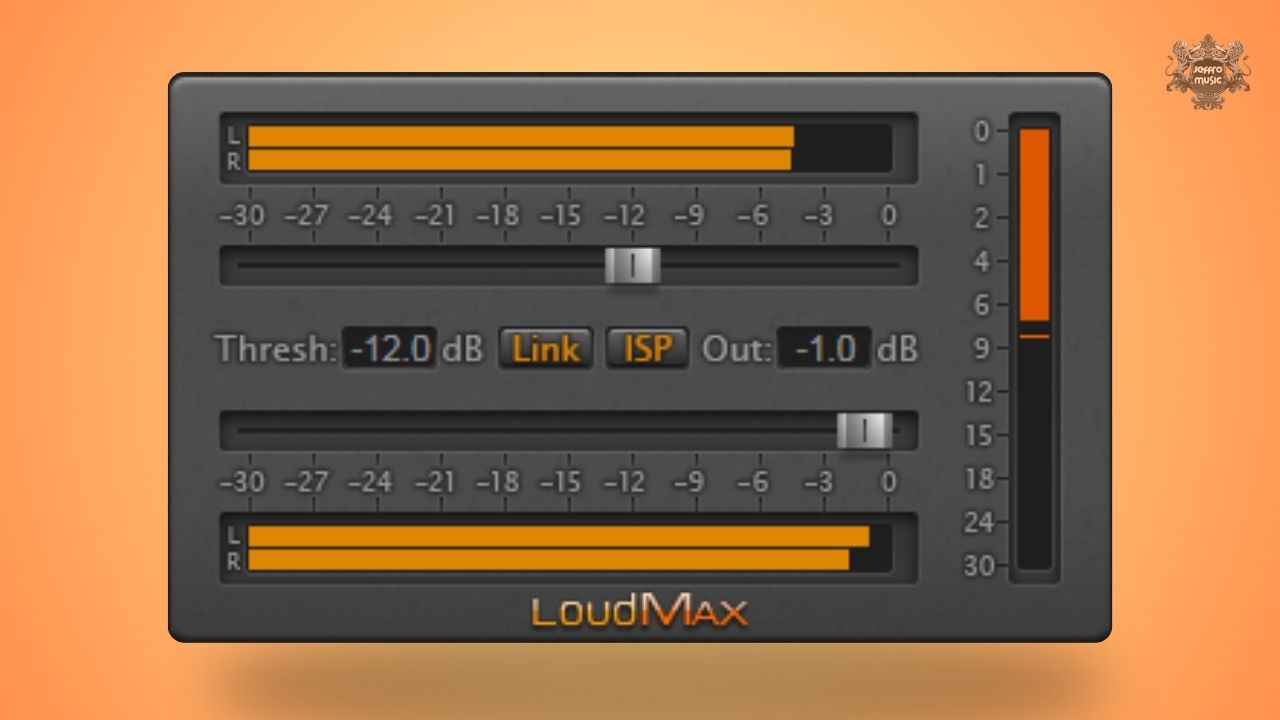
LoudMax is a free look-ahead brickwall loudness maximizer designed with one clear goal: achieve competitive loudness while preserving the original character of the music. It’s deliberately minimal, avoiding feature bloat in favor of transparent limiting that holds together even at high gain reduction.
That focus has made LoudMax a long-standing favourite for mastering engineers, broadcasters, and producers who want reliable results without second-guessing the processor.
At its core, LoudMax is a true look-ahead limiter with automatic, program-dependent release behaviour. This allows it to react quickly to transients while recovering smoothly, avoiding pumping and distortion even under heavy limiting.
The sound remains clean and controlled, making it especially effective as a final-stage limiter on mixes, masters, or broadcast chains.
With inter-sample peak (ISP) detection enabled, LoudMax calculates additional samples between each audio sample to reduce true-peak overshoots. This is critical for modern delivery formats, where encoding and sample-rate conversion can introduce unexpected clipping if peaks are not properly controlled.
LoudMax keeps things intentionally simple. There are just two main controls: Threshold and Output. A linking option lets the output level move in tandem with the threshold, speeding up loudness matching.
Clear meters show input, output, and gain reduction, allowing precise control without visual clutter.
Despite its simplicity, LoudMax supports extremely high internal headroom, very low CPU usage, and a wide range of sample rates, making it dependable in both lightweight setups and professional mastering environments.
A no-nonsense brickwall limiter trusted for clean loudness.
Its transparency and predictable behaviour make it ideal as the last processor in a chain, especially when avoiding audible distortion is critical.
ISP is recommended for mastering and streaming delivery. It slightly increases CPU usage and latency but significantly improves true-peak accuracy.
Yes. ISP filtering and true peak monitoring are included in the free version, making it safe for streaming delivery.
Within reason, yes. The dynamic algorithm and clipping stage allow higher loudness with fewer artefacts than many basic limiters.