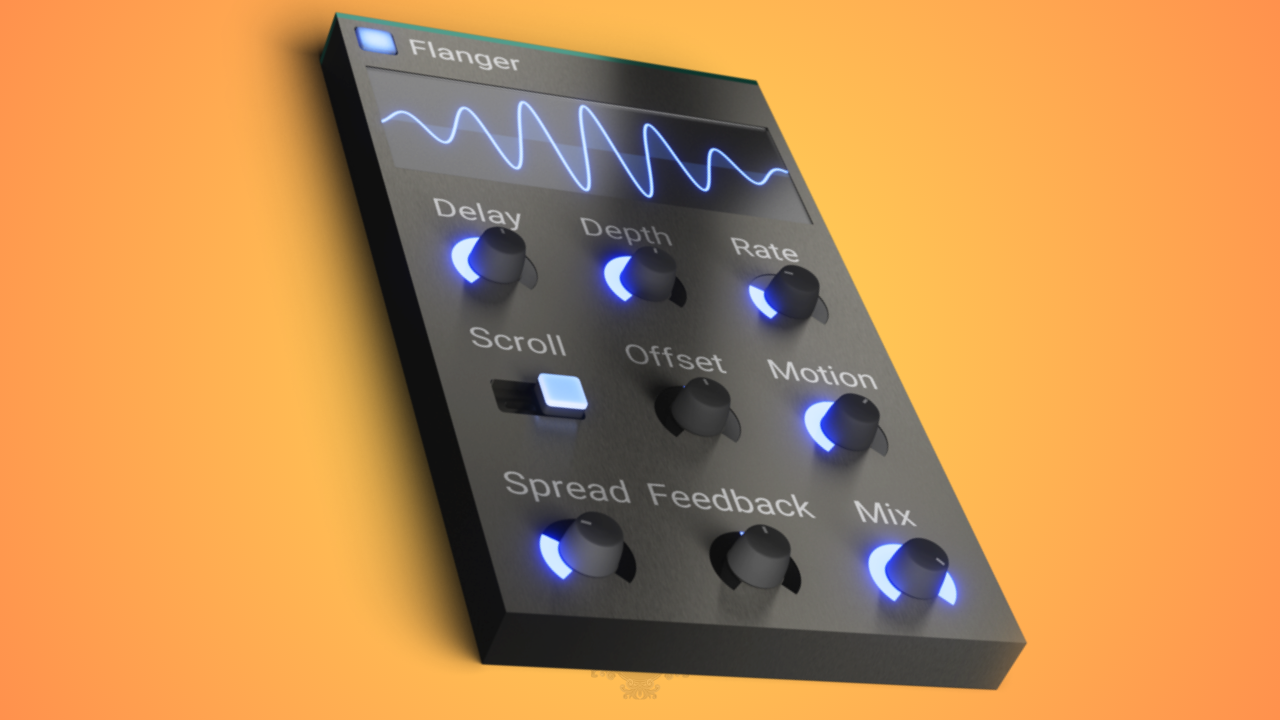
Kilohearts Flanger is built on the classic recipe: mix your signal with a slightly delayed copy of itself, then modulate that delay to create moving comb-filter notches across the spectrum. The strength here is how directly it exposes the “producer knobs” that actually matter.
Delay sets the minimum delay time, Depth determines how far the modulation pushes above that, and Rate controls how fast the sweep moves.
In practice, this makes it quick to dial in everything from subtle stereo motion on pads and vocals to harder, jet-like sweeps on drums, synth stabs, and FX returns.
Feedback pushes the resonant peaks harder and can make the effect feel more aggressive, while Mix keeps the processing controllable in a modern mix context.
Where Kilohearts Flanger gets more distinctive is Scroll. Enable it and the plugin adds a phase offset and “motion” system that can create an infinite barberpole-style flanging effect, either rising or falling.
That’s the type of movement that’s perfect for transitions, drones, build-ups, and sound design moments where a normal cyclic flanger feels too obviously “back and forth.”
Spread handles stereo width by offsetting the modulation behavior between left and right channels. Used lightly, it adds width without turning the effect into a washy stereo mess.
Used harder, it becomes a wide, animated modulation layer that can make static sources feel like they’re rotating in space.
A no-nonsense stereo flanger with asymmetric feedback and a distinctly musical edge.
Keep Depth modest, lower Mix, and avoid extreme Feedback. The low end is where comb filtering can feel like “missing fundamentals,” so treat it like seasoning, not a replacement for EQ.
Offset sets the phase offset relationship between dry and wet. Spread offsets the behavior between left and right channels, which affects both delay modulation and the phase offset system. If Offset is the motion character, Spread is the stereo staging.
Enable Scroll, then use Motion to control how fast the phase offset is being modulated. Small Delay and moderate Depth typically read more “continuous climb” than wide, slow sweeps.
For tone movement, put it after saturation so harmonics get animated. For cleaner widening, put it before reverb and delay so the ambience inherits the motion without doubling the notches.