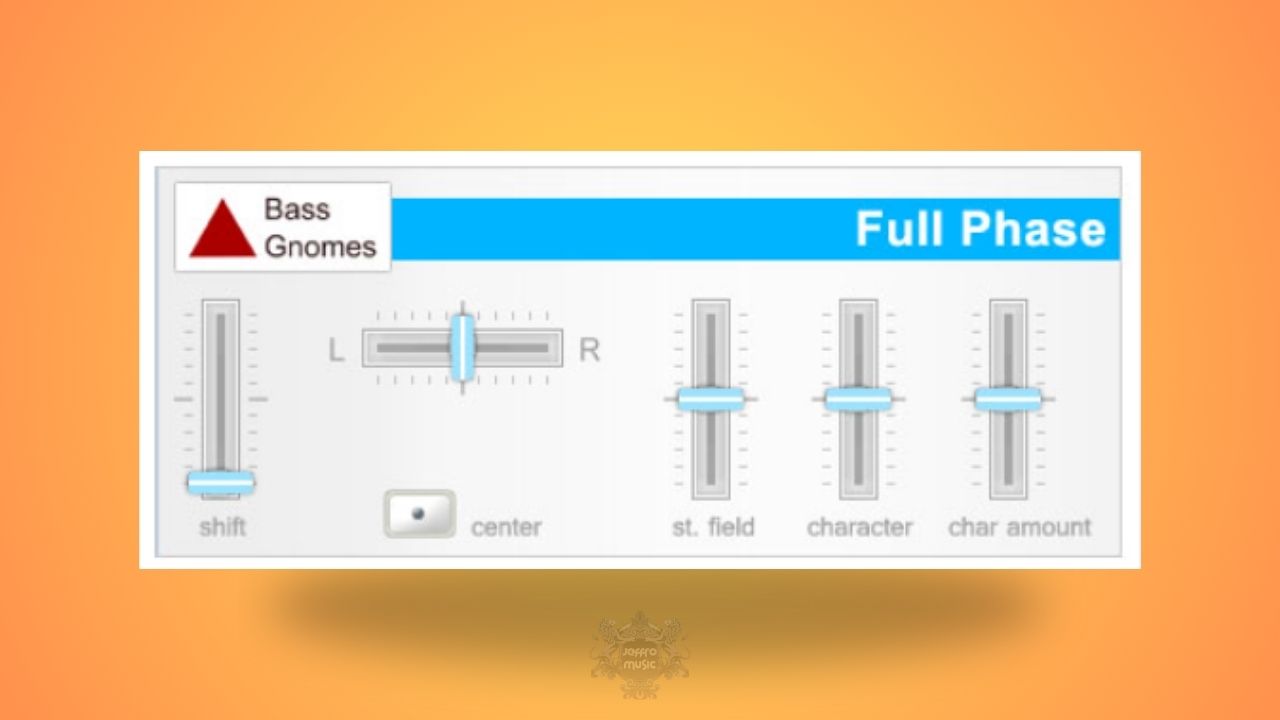
Full Phase VST is a distinctly different take on phasing, focusing on stereo field interaction rather than traditional sweeping filter stages. Instead of classic notch-based modulation, it works by inverting one stereo channel and phasing it against the opposite channel to isolate shared spatial information.
The result is a phase processor that feels surgical and spatial, capable of enhancing width, movement, and stereo character without overwhelming the source.
At the core of Full Phase VST is a process that targets common stereo field characteristics by phasing each channel against its counterpart.
This approach allows the plugin to reshape spatial information directly, making it especially effective on stereo material where width and positioning matter.
A compact phase-shift network sits at the heart of the effect, controlled by the Character slider. This parameter defines how pronounced the phase interaction becomes, ranging from subtle stereo refinement to more obvious phase coloration.
Rather than sweeping continuously, the effect feels tuned and intentional, lending itself well to precise spatial adjustments.
Phase movement is driven by the Shift control, which determines the intensity of the phase offset. This works in tandem with the Left ↔ Right horizontal slider, allowing you to position the phase interaction across the stereo image.
You can bias the effect toward one side, centre it, or gently animate the stereo field without destabilising balance.
The ST (Stereo Field) slider introduces mid/side-style behaviour, adjusting how the phase processing interacts with the centre versus the sides.
This makes Full Phase VST particularly useful for widening static sounds, adding motion to pads, or subtly reshaping stereo buses while maintaining mono compatibility when used conservatively.
A phase processor designed around stereo perception rather than classic phaser sweeps.
It manipulates stereo phase relationships directly instead of sweeping multiple all-pass filters, resulting in a more spatial and less tonally coloured effect.
Stereo pads, textures, synth layers, and buses benefit most, especially when subtle movement or width enhancement is required.
Yes. Lower Shift and Character settings allow gentle stereo enhancement without obvious phasing or comb filtering.
It’s primarily designed for stereo material, but mono sources can gain width when processed carefully in a stereo context.