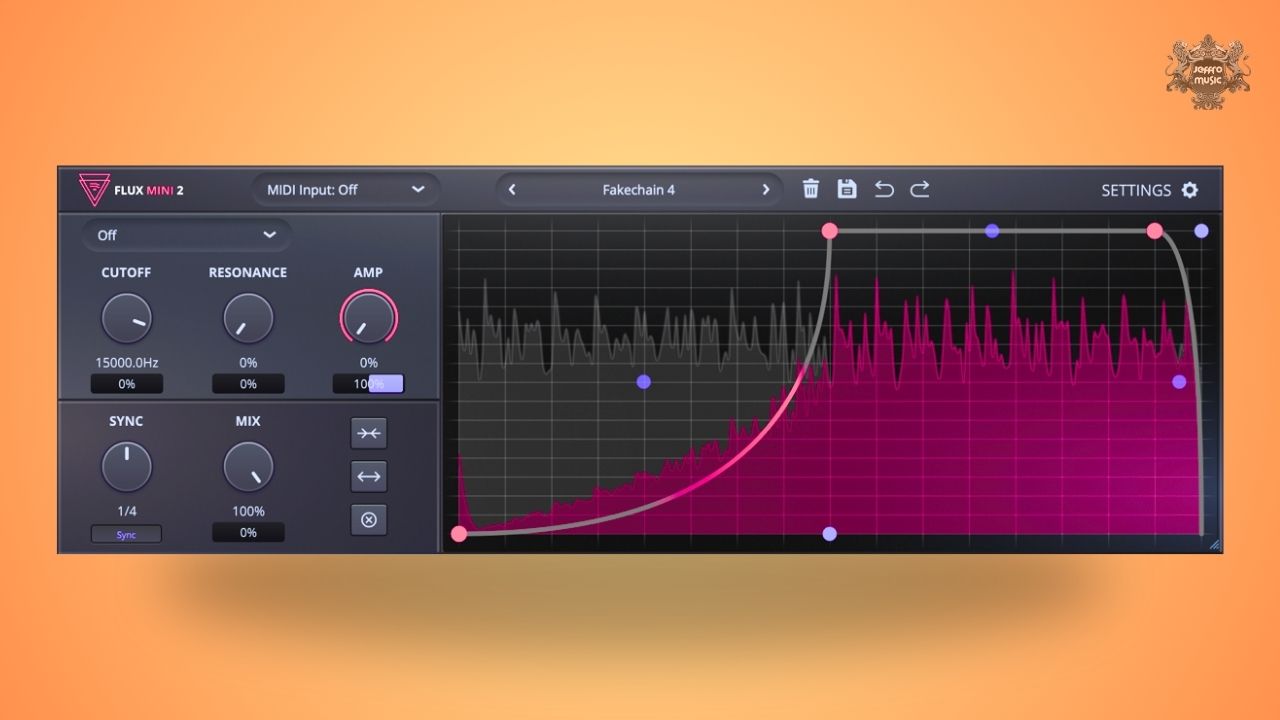
Flux Mini 2 is a free modulation and filter effect designed to inject life and motion into static sounds with minimal setup.
Built around a powerful, drawable automation graph, it lets you sculpt rhythmic movement, dynamic filter sweeps, and animated amplitude shaping in seconds.
Whether you’re adding subtle groove or pushing into manic modulation territory, Flux Mini 2 keeps things musical, fast, and intuitive.
At the centre of Flux Mini 2 is its customisable automation graph. Using Bézier curves, you can draw precise modulation shapes and assign them to filter cutoff, resonance, amplitude, or mix.
Depth controls beneath each target let you fine-tune how much influence the graph has, making it easy to dial in anything from gentle movement to aggressive pumping effects.
The graph can be synced to host tempo or locked to milliseconds, and you can stack, duplicate, or repeat shapes within a cycle for more complex rhythmic patterns. It’s modulation that feels visual, tactile, and immediate.
Flux Mini 2 includes low-pass, band-pass, and high-pass filters, making it suitable for classic sidechain-style effects, rhythmic filtering, and tonal animation. MIDI triggering adds another performance layer, allowing one-shot envelopes or retriggered modulation from incoming MIDI notes.
Uniquely, the modulation graph can also be output as MIDI CC, letting Flux Mini 2 act as a control source for other plugins. This turns it into a lightweight modulation hub rather than just an effect, opening up deeper routing and automation possibilities.
With a clean, modern interface and 20 factory presets, Flux Mini 2 is easy to jump into. Presets range from subtle fake sidechains to more experimental, tempo-synced movement, serving both as ready-to-use tools and starting points for custom shapes.
A built-in visualiser mode can even turn the graph into a live waveform display, helping you see modulation in action.
A flexible modulation tool built for speed and creativity.
No. While it excels at sidechain-style movement, the graph-based modulation makes it far more flexible than a traditional LFO or envelope follower.
Yes. A single graph can drive several parameters simultaneously, each with independent depth control.
Very. It allows Flux Mini 2 to control external plugins, turning it into a creative modulation source beyond its own filter and amp stages.
Absolutely. It scales well from gentle rhythmic motion to aggressive, tempo-locked modulation.