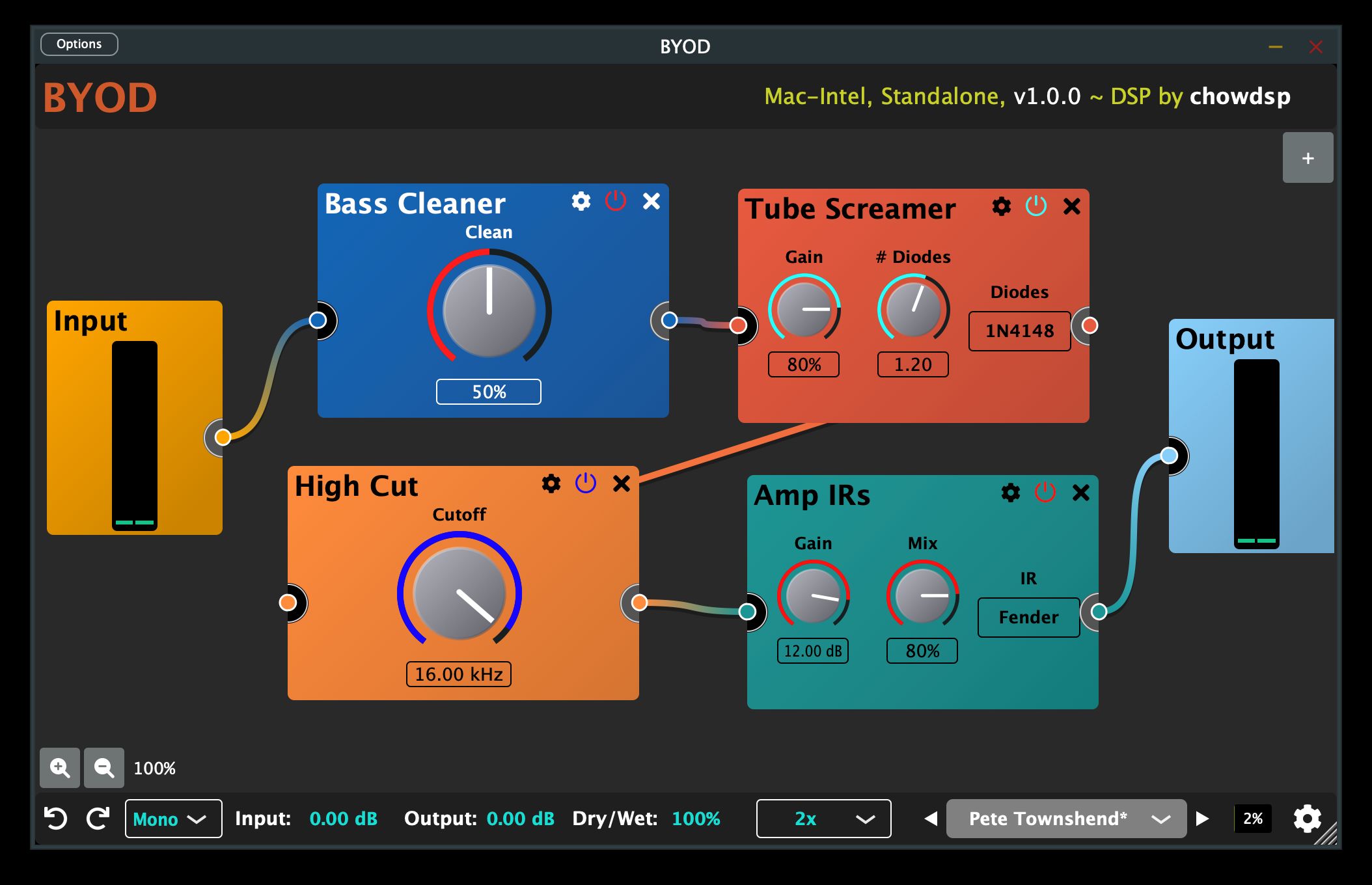
BYOD, short for Build-Your-Own-Distortion, is a modular effects plugin that lets you design custom distortion and guitar processing chains from the ground up.
Developed by ChowDSP, it brings pedalboard-style flexibility into a fully modular digital environment, combining emulations of classic distortion circuits with tone shaping, modulation, and utility processors.
While guitar distortion is the core focus, BYOD is equally capable as a creative sound-design tool for synths, drums, vocals, and experimental processing.
BYOD is built around a node-based processing chain, where audio flows through individual processors connected by virtual cables. Each processor represents a specific circuit or effect stage, such as distortion, EQ, filtering, modulation, or dynamics.
You can freely add, remove, duplicate, or reorder processors, replacing cables with new modules on the fly to reshape the signal path without interrupting workflow.
This modular structure allows complex routing setups that go far beyond traditional pedal chains. Parallel processing, feedback-style routing, and unconventional signal flows are all possible, making BYOD as much a creative sandbox as it is a guitar effects plugin.
Undo support throughout the entire system encourages experimentation without risk.
Beyond standard audio routing, BYOD introduces modulation ports and level ports that allow processors to share control signals. Modulation processors can drive multiple targets from a single source, keeping LFOs and envelopes perfectly in sync across the chain.
Level ports allow dynamic processors to share envelope data, enabling advanced interactions like sidechain-style behaviour or coordinated dynamics shaping.
Each processor includes its own on/off control and settings menu, with options to reset parameters, duplicate modules, or swap processors instantly.
This makes it easy to audition different circuit types in the same position within a chain, a powerful feature when designing distortion tones or comparing subtle variations in gain staging.
Despite its depth, BYOD is designed to remain approachable.
Processors are added via a simple context menu or toolbar button, connections are made by dragging between ports, and the interface clearly distinguishes audio, modulation, and level signals through colour coding.
The plugin is also open-source, with nightly builds available for users who want access to the latest experimental features.
BYOD runs across an unusually wide range of platforms and formats, including desktop, mobile, and standalone use.
This makes it equally useful in traditional DAW sessions, live performance setups, or mobile production workflows.
A flexible modular environment for distortion and beyond.
Instead of a fixed signal path, BYOD allows complete freedom over routing and processor order, enabling parallel chains, shared modulation, and unconventional distortion structures.
Can BYOD be used for non-guitar material?
They allow multiple processors to receive the same modulation signal, ensuring synchronised movement across filters, distortion stages, or effects without duplicated LFOs.
Yes. The modular design makes it ideal for feedback-style routing, layered distortion paths, and evolving effect chains that would be difficult or impossible in fixed plugins.