Delay Studio
Delay Studio
Delay plugins are rarely subtle. They either sit quietly in the background or dominate the mix with obvious repeats and washed-out tails.
Delay Studio by Minimal System Group takes a different approach. Built as an entry to the KVR Developer Challenge, this Windows-only multiband delay was designed for producers who want precision as much as personality.
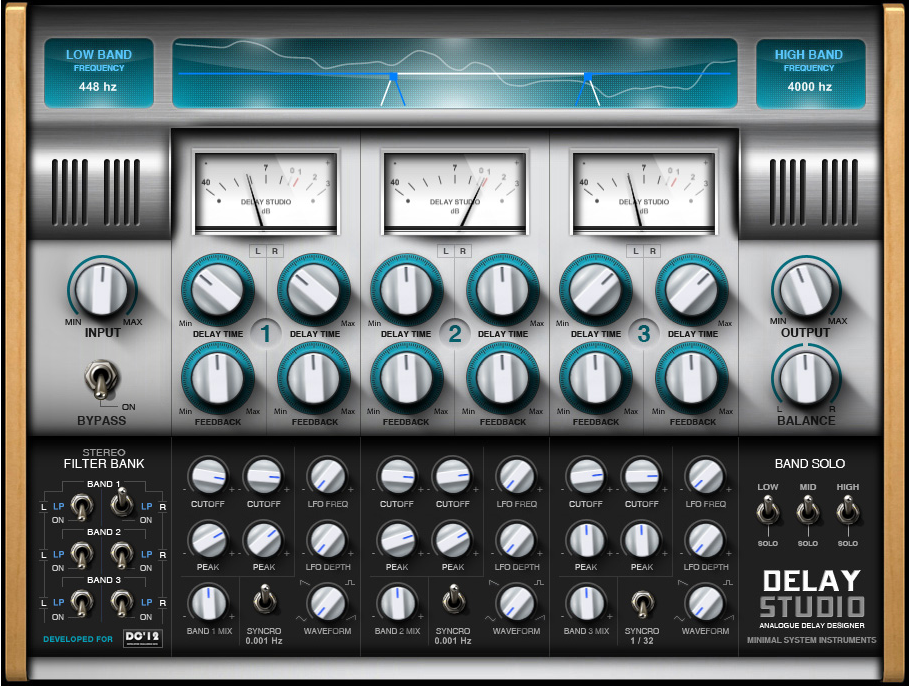
At its core, Delay Studio splits your signal into three fully configurable bands – Low, Mid and High – each with independent stereo control, filtering and modulation. That means you’re not just adding echo; you’re shaping space frequency by frequency.
Low-end dub-style movement, midrange rhythmic taps and shimmering high-end trails can all exist independently inside one instance.
- 32-bit
- VST, AU, and AAX
- Windows
- OSX
Three-Band Architecture for Precision Control
Delay Studio divides the signal into Low, Mid and High bands with full frequency range control from 0 Hz to 20 kHz. Each band can be adjusted to sit exactly where you need it in the spectrum, allowing surgical placement of delay energy.
For producers working in dense arrangements, this is key. Instead of muddying the low end or cluttering vocals, you can isolate delay to specific frequency regions. It’s particularly useful in drum and bass, garage and electronic productions where low-end clarity is everything.
Independent Stereo & Modulation Depth
Each band is split into left and right channels, with independent delay time and feedback controls. This opens up serious stereo design potential. Subtle width enhancement, ping-pong patterns or asymmetrical rhythmic echoes are all possible without stacking multiple plugins.
The comprehensive filter bank adds another layer. Every band features fully controllable filters on both channels, with Low Pass, High Pass, Band Pass, Peaking and Band Reject options. Six filters and six multimode LFOs allow tempo-synced or free-running modulation, giving you evolving delay textures rather than static repeats.
Analogue-Inspired Crossover & Workflow Focus
Minimal System Group built Delay Studio on an accurate crossover algorithm modeled on analogue hardware principles. The aim is clean band separation without digital harshness.
Workflow also feels considered. All controls are front-facing with no hidden menus, making sound design fast and intuitive. VU meters on every band provide visual feedback, while input and output controls make gain staging straightforward.
Despite its flexibility, CPU usage remains low, meaning you can run multiple instances without overwhelming your system.
Key Features:
Sculpt Your Echo. Control Your Space.
- Three fully configurable delay bands (Low / Mid / High)
- Frequency range control from 0 Hz to 20,000 Hz
- Analogue-inspired crossover algorithm
- Independent left and right delay time and feedback per band
- Six multimode LFOs (tempo synced or free running)
- Six filters with multiple filter types
- VU meters on all bands
- Input and output level controls
- Stereo balance control
- Full automation and MIDI mapping support
FAQ
No. Delay Studio is Windows-only and available as a 32-bit VST. It can run in 64-bit systems via jBridge or DAW bridging.
It depends on the DAW. Delay Studio is a 32-bit VST plugin, so it will not load natively in most modern 64-bit-only DAWs.
However:
Some DAWs include built-in 32-bit bridging (for example older versions of Cubase, Reaper, FL Studio, etc.).
You can use a third-party bridge such as jBridge to run it in 64-bit environments.
Important caveat:
Many current DAWs have removed 32-bit support entirely, so compatibility is no longer guaranteed. Always test the demo or confirm your DAW still supports bridging before committing to it.
Its three-band architecture with independent stereo control and modulation allows far more detailed shaping than single-band delays.
Absolutely. You can use it for gentle high-end shimmer, controlled midrange slapback or restrained stereo widening.