M Analyzer
M analyzer
Advanced Spectral Analyzer & Sonogram with Scientific-Grade Control
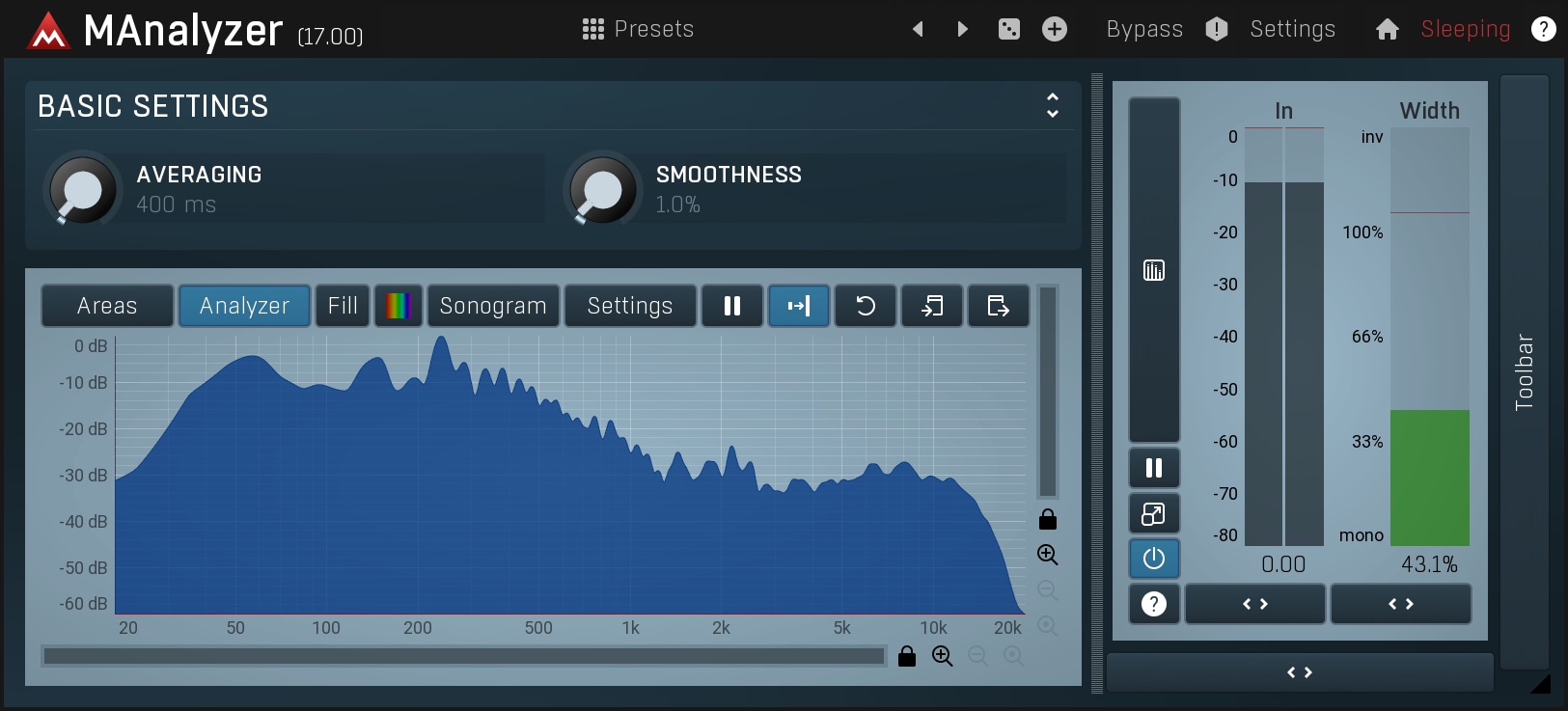
MAnalyzer is a powerful real-time spectral analyzer and sonogram designed for engineers who demand more than a basic FFT display.
Built by MeldaProduction, it combines highly detailed frequency analysis with advanced psychoacoustic tools such as normalization, deharmonization, super-resolution processing, and customizable prefiltering.
Unlike standard analyzers that simply visualize frequency energy, MAnalyzer offers a deeply configurable analysis engine with scientific precision and musical usability.
Whether you’re diagnosing low-end buildup, identifying masking, or performing forensic-level analysis, MAnalyzer delivers exceptional clarity across the full spectrum.
System Requirements:
- 64 bit
- VST / AU / AAX
- Windows
- macOs
Deep Spectral Analysis with Musical Intelligence
At its core, MAnalyzer is a highly flexible FFT analyzer capable of measuring average, infinite average, temporary maximum, and infinite maximum spectral states. FFT sizes range from 1024 to 16384, with adjustable window types, overlapping, and analytical smoothing options for precise control over time versus frequency resolution.
One of its standout features is Super-Resolution mode, which enhances low-frequency detail without sacrificing high-frequency responsiveness.
Traditional FFT analyzers struggle with bass resolution due to the logarithmic nature of human hearing. MAnalyzer compensates by improving low-end clarity while maintaining speed and accuracy in higher ranges.
Additional scientific tools include:
- Deharmonization, which suppresses harmonics to isolate fundamental frequencies. This is invaluable when identifying root notes, bass conflicts, or tuning inconsistencies.
- Magnitude normalization, allowing more meaningful visual comparison between different sources.
- Peak detection with adjustable thresholds, useful for isolating dominant resonances.
- Time resolution controls, enabling tighter transient tracking when required.
For visual clarity, smoothing spreads energy between frequency bands to create easier-to-read curves without compromising analytical depth.
Sonogram, Multi-Channel & Advanced Metering
Beyond the spectrum display, MAnalyzer includes a detailed sonogram view, mapping frequency over time using customizable color schemes. This provides superior temporal context for evolving material, making it easier to track movement, modulation, and transient behavior.
The plugin supports:
- Stereo, mono, and mid-side analysis
- Multi-channel routing
- Surround processing (up to 8 channels)
- Ambisonics support (up to 7th order / 64 channels, where supported by the DAW)
Integrated metering includes:
- Peak metering
- True peak detection
- RMS measurement
- EBU R128 loudness metering
- ITU-R BS.1770-3 compliance
Stereo width and correlation metering
These tools make MAnalyzer equally valuable in mixing, mastering, broadcast preparation, and immersive audio workflows.
Prefiltering & Psychoacoustic Analysis
One of MAnalyzer’s most advanced capabilities is Prefiltering, which applies frequency shaping before analysis. This allows you to simulate equal-loudness contours and approximate human auditory perception rather than purely mathematical amplitude measurement.
Instead of seeing raw scientific frequency energy, you can visualize how the ear actually responds across the spectrum. This is especially useful when balancing mixes for translation and tonal realism.
Depth control lets you blend between raw FFT data and psychoacoustic modeling.
Key Features:
MAnalyzer is a precision analytical environment built for engineers who want clarity, depth, and control over every aspect of spectral evaluation.
- Advanced FFT analyzer with 1024–16384 FFT sizes
- Super-Resolution mode for enhanced low-frequency detail
- Deharmonization for isolating fundamental frequencies
- Magnitude normalization for improved visual comparison
- Adjustable smoothing and analytical smoothing algorithms
- Peak detection with configurable threshold
- Average, infinite average, temporary maximum, and infinite maximum modes
- Real-time sonogram display with customizable color gradients
- Multi-channel, stereo, mid-side, surround, and ambisonics support
- True peak, RMS, EBU R128, and ITU-R BS.1770-3 loudness metering
- Stereo width and correlation meter
- Prefiltering with equal-loudness contour modeling
- Overlapping FFT processing for higher precision
- Adjustable window types and time resolution controls
- Copy/paste analysis comparison between instances
- Freeze mode for detailed inspection
FAQ
Increasing FFT size improves low-frequency resolution but slows overall response. Super-Resolution maintains fast high-frequency tracking while selectively enhancing bass detail, providing clearer sub information without sluggish display behavior.
Deharmonization is ideal when identifying fundamental pitch in harmonically dense material. It reduces harmonic clutter, making root frequencies easier to isolate during tuning analysis or mix diagnostics.
Analytical smoothing preserves proportional relationships between frequencies while reducing visual noise. It is more CPU-intensive but better suited for technical evaluation and mastering-level inspection.
No. Normalize is strictly visual. It adjusts how spectra are displayed, not how audio is processed. It is particularly useful for comparing tonal balance between two signals.
Yes. With built-in EBU R128 and ITU-R BS.1770-3 loudness metering, along with true peak detection, it supports professional loudness measurement workflows for broadcast and streaming contexts.