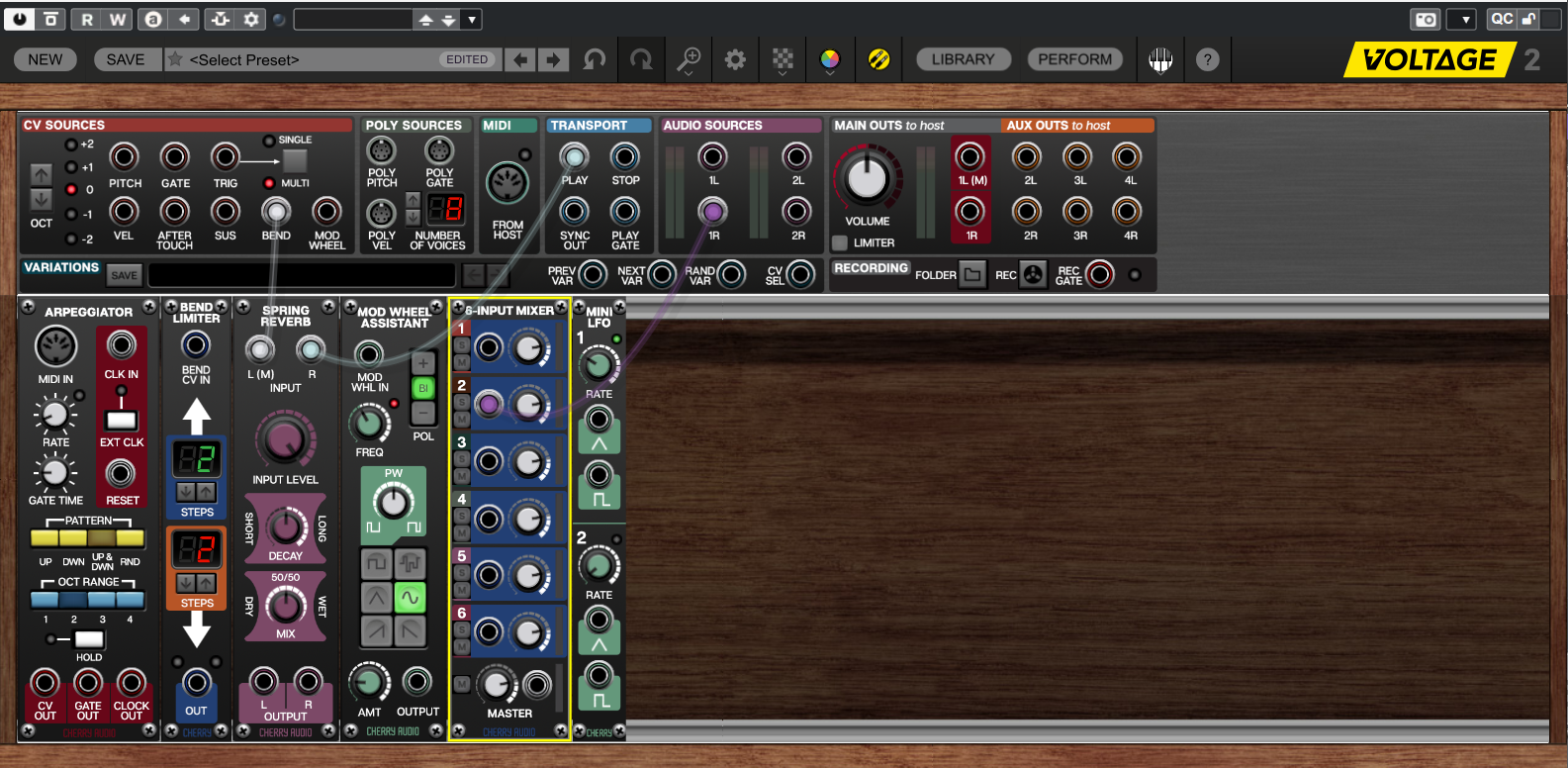
Voltage Modular 2
Voltage Modular 2
Voltage Modular 2 is Cherry Audio’s most ambitious statement yet in the world of software modular synthesis. Already regarded as one of the deepest and most playable virtual modular environments available, version 2 pushes far beyond a simple update.
This is a full-scale rethink of how modular synthesis should work in software, removing physical limitations while preserving the immediacy and joy of patching.
Now fully Apple Silicon native on macOS and heavily optimized on Windows, Voltage Modular 2 delivers massive performance gains alongside workflow innovations that simply are not possible in hardware modular systems.
System Requirements:
- 64 bit
- VST / AU
- Windows
- macOs
A modular system that breaks the rules
Voltage Modular 2 obliterates traditional patching constraints. Every jack supports unlimited cables, removing the need for mult modules entirely. Want one LFO driving 12 destinations? Just patch it.
Want to reroute everything mid-performance? Cables can be moved, shifted, and reassigned at any time without breaking audio.
The new Bus system is a standout addition. Inputs and outputs can be assigned to buses, where all signals are automatically summed and made available anywhere else in the patch.
Inspired by classic semi-modular systems like the ARP 2500 and EMS VCS3, buses dramatically reduce cable clutter while enabling complex signal routing that would be impractical even in large hardware rigs.
Variations: modular meets performance
Perhaps the most forward-thinking feature in Voltage Modular 2 is Variations. Think of these as snapshots of an entire patch, including knob positions, switch states, and routings. But instead of being static recalls, Variations are playable.
You can step through variations via triggers, CV, or modulation, effectively morphing entire modular systems in real time.
This opens the door to evolving sequences, performance macros, and generative patches that would normally require enormous control rigs or external automation.
Built for modern workflows
Voltage Modular 2 is packed with workflow improvements that make long modular sessions far less chaotic:
- Optional auto-alignment keeps cabinets tidy
- Custom module categories and multi-term search tame large libraries
- Instant cable hide/show speeds up navigation
- Modules support bypass and randomization for rapid experimentation
The updated IO Panel now includes integrated recording, capturing pristine 32-bit floating-point audio directly from the main outputs. This makes it easy to bounce modular performances without routing audio back into a DAW.
Sound quality and performance
Under the hood, Voltage Modular runs on 64-bit double-precision processing, with zero-latency, per-sample module operation. This ensures rock-solid audio-rate modulation, clean oscillator sync, aggressive FM, and stable feedback paths, even in extremely complex patches.
Despite its depth, Voltage Modular remains efficient and responsive, scaling well across modern CPUs and benefiting heavily from Apple Silicon optimization.
Expandable ecosystem
Voltage Modular is designed to grow with you. An integrated module browser and store lets users install free or paid modules directly inside the software, with no external installers.
Cherry Audio and third-party developers continue to expand the ecosystem with oscillators, effects, utilities, and complete instruments.
Key Features:
For newcomers, Voltage Modular Nucleus is available completely free, offering 22 modules and a fully functional modular environment to learn the fundamentals.
- Unlimited cables per jack
- Bus-based signal routing
- Variations system for patch morphing and performance
- Integrated 32-bit floating-point recording
- 64-bit double-precision audio engine
- Zero-latency, per-sample processing
- Module bypass and randomization
- Auto-alignment and cable management tools
- Custom module categories and advanced search
- Expanding in-app module ecosystem
- Plugin and standalone operation
FAQ
They serve different philosophies. Voltage Modular focuses on workflow, polish, and plugin integration, while VCV Rack emphasizes open-source modular diversity. Many users run both side by side.
Yes. Unlike some modular platforms, Voltage Modular works as a plugin, making it ideal for hybrid DAW-modular workflows.
No. Voltage Modular Nucleus is free and fully usable, with enough modules to learn modular synthesis properly.
Absolutely. Variations, cable rerouting, and real-time control make it particularly strong for performance-oriented modular setups.
Yes. Voltage Modular 2 runs natively on Apple Silicon for improved performance and efficiency.