Tripple Cheese VST
Triple Cheese
Cooking up sonic oddities since its 2006 KVR Developer Challenge win, u-he’s Triple Cheese remains one of the most delightfully left-field freeware synths in the game.
Bypassing the standard oscillator-and-filter blueprint, it leans into comb-filter-based synthesis to generate its unique character. It’s quirky, unashamedly retro, and capable of delivering surprisingly lush textures once you dig beneath that “cheesy” exterior.
System Requirements:
- 32 bit
- 64 bit
- VST / AU
- Windows
- macOs
Comb Filters as the Core Engine
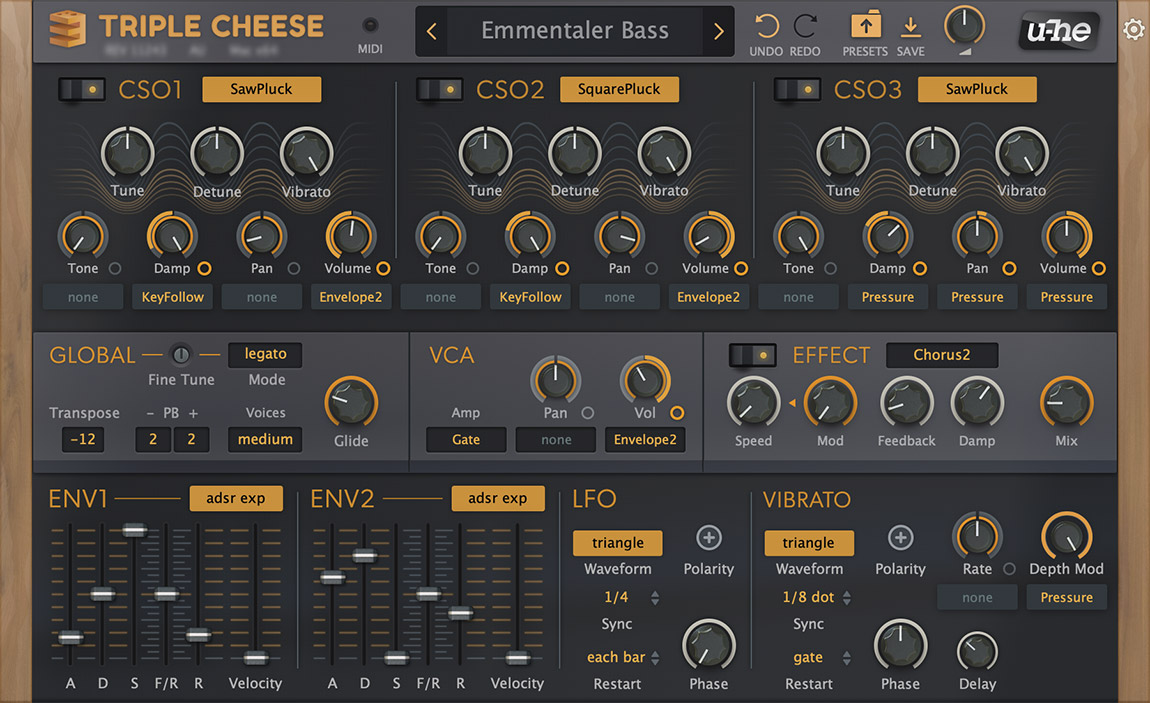
Triple Cheese abandons classic synthesis architectures in favour of three chromatically tuned comb filter modules arranged in series.
If you think of a comb filter as a very short, pitch-tuned delay line, you are on the right track. Each module can either generate its own excitation signal or process the output of the previous module, allowing for layered and evolving timbres.
Each comb module features multiple operational modes, giving a total of eleven sound-generation options across the engine. These modes range from plucked and percussive resonances to more sustained, synthetic textures.
Because the engine is fundamentally delay-based rather than oscillator-based, the harmonic structure behaves differently to subtractive or wavetable synths. Overtones bloom in a more resonant, sometimes metallic way. Transients feel sharper. Sustains can feel airy or glass-like.
On paper, it sounds minimal. In practice, it is capable of surprisingly lush pads, string-like textures, digital bells, and animated atmospheres.
Push the modules in series with subtle detuning and modulation, and Triple Cheese moves from “quirky digital” into rich, layered sound design territory.
Voice Architecture and Playability
Triple Cheese supports up to 16 voices of polyphony, alongside duophonic, monophonic retriggered, and legato modes.
That flexibility makes it equally comfortable for chordal pad work, layered harmonics, or focused lead lines.
The amplitude section includes modulation and stereo panning options, allowing movement across the sound field without relying solely on external effects. Because the synthesis engine itself is relatively lightweight compared to modern heavyweight wavetable synths, Triple Cheese remains efficient enough to layer multiple instances in larger projects.
One overlooked strength is how responsive it feels under performance controls. Velocity, key follow, mod wheel, and aftertouch can all be routed to meaningful destinations. It may look minimal, but it rewards expressive playing.
Modulation That Adds Character
Despite its streamlined layout, Triple Cheese offers a capable modulation system. Classic sources such as LFO, envelope, mod wheel, velocity, pressure, and key tracking can be assigned to key parameters throughout the synth.
The LFO is particularly effective when used subtly. Gentle modulation of comb tuning, damping, or amplitude introduces organic motion that offsets the inherently digital tone. Push it further, and you can create shimmering pads or rhythmic pulsing textures.
Envelope modulation can reshape attacks and decays dramatically. Because comb filters behave like resonant delay lines, envelope shaping has a different flavour compared to subtractive synthesis. Instead of simply opening a filter, you are effectively shaping resonance behaviour. That difference gives Triple Cheese its unique sonic fingerprint.
Version 1.3 also introduced support for Oddsound MTS-ESP microtuning, opening the door to alternative scales and experimental harmonic structures. For sound designers working outside standard Western tuning, this significantly expands creative scope.
Key Features:
For ambient textures, digital strings, glassy plucks, evolving pads, and slightly nostalgic timbres, Triple Cheese still holds its own.
- Three comb filter modules arranged in series
- Eleven total sound generation modes
- Up to 16-voice polyphony
- Mono, duo, and legato modes
- 254 factory presets
- Built-in chorus, flanger, phaser, delay, and reverb
- Flexible modulation routing
- Skinnable interface
- Oddsound MTS-ESP microtuning support
FAQ
It definitely leans “digital vintage” by nature, but it can do modern pads if you treat it like a resonator synth rather than a VA. Use slow envelopes, gentle LFO movement on tuning or damping, keep the comb feedback under control, and let chorus plus reverb do the widening. The sweet spot is evolving, glassy, airy textures rather than “warm analogue.”
Layering and mid control are everything. Double it with a simple sine or saw layer from another synth for fundamentals, then high-pass Triple Cheese slightly so it owns the shimmer and character.
Inside Triple Cheese, use subtle stereo movement, light modulation, and avoid extreme resonance peaks that poke out around 2–5 kHz.
Shorter decays, lower brightness, and dirt outside the plugin. Triple Cheese can supply the plucky resonant tone, then you can run it into tape saturation, a gentle low-pass, and a wow and flutter effect. It naturally does “dusty digital keys” and plucked textures that feel perfect for lofi chords.
It can do bass-adjacent tones, but it’s not a dedicated sub machine. Comb-based synthesis often emphasises harmonics and resonances more than stable low fundamentals. If you want bass that hits on a system, layer a clean sub underneath and let Triple Cheese provide the mid bite or metallic edge.
Start with a pluck-style mode, keep the envelope attack near instant, set a short decay, low sustain, and moderate release. Then adjust the comb tuning and feedback until the resonance feels like a string body. A tiny amount of chorus and a short room reverb usually finishes it.
Yes. Triple Cheese supports Oddsound MTS-ESP, so if you’re working with microtuning setups via MTS-ESP, it can follow those tunings. That makes it a fun option for unusual harmonic pads and non-12TET plucks.
Generally yes, but it depends on your host and OS. It’s been around a long time and is widely used, so the basics are solid. The biggest “gotcha” tends to be format support, especially if you rely on AAX on macOS.