Azimuth VST
Azimuth
Azimuth is a refreshingly straightforward virtual analog and wavetable synthesizer that focuses on immediacy, clarity, and hands-on sound shaping.
Rather than overwhelming you with pages of menus or hidden modulation routes, Azimuth puts everything front and center on a single, clean interface.
It’s designed for producers who want to dial in wide pads, animated textures, and expressive synth sounds quickly, while still offering enough depth to reward experimentation.
System Requirements:
- 64 bit
- VST / AU
- Windows
- macOs
Virtual analog weight with wavetable flavour
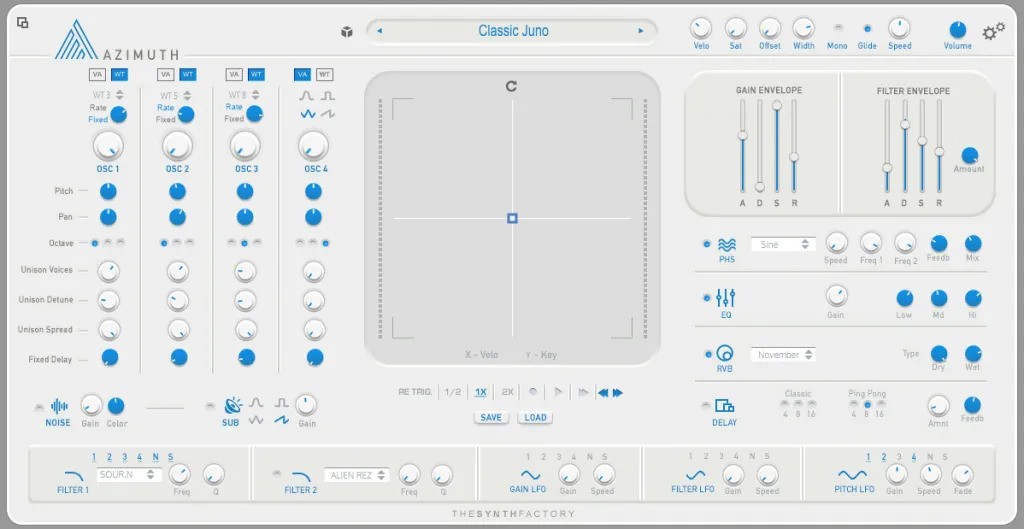
At the heart of Azimuth are four oscillators, each capable of up to eight unison voices per voice, giving the synth a naturally wide and powerful sound.
Alongside its virtual analog engine, Azimuth includes a wavetable oscillator mode that adds extra harmonic character without turning the synth into a full-on sound mangler. This balance makes it easy to create rich pads, evolving chords, and modern electronic tones without losing focus.
Each oscillator can be independently panned and delayed, opening up natural stereo movement and spacious textures with minimal effort. A sub-oscillator and noise generator sit alongside the main oscillators, giving you plenty of raw material for basses, leads, and atmospheric layers.
Movement, modulation, and hands-on control
Azimuth features two multimode filters, with one operating per voice and the second acting globally, allowing for complex motion and evolving timbres.
Modulation is handled via three dedicated LFOs targeting gain, filter, and pitch, all assignable across oscillators, sub, and noise sources.
The centerpiece of the synth is its large X/Y pad, which enables vector-style blending between oscillator levels. You can record movements, assign them to velocity or key tracking, and sync playback to your DAW for rhythmic modulation.
While it doesn’t offer wave sequencing, the X/Y pad still delivers expressive, performance-ready sound shaping reminiscent of classic vector synths.
Azimuth rounds things off with four master effects: phaser, EQ, reverb, and delay. The phaser adds lush movement, the delay handles synced echoes and ping-pong patterns, and the reverb provides quick spatial depth without fuss. Everything stays focused on speed and usability.
Key Features:
This synth pairs wavetable flexibility with a high-density unison engine and recordable XY modulation for rhythmic timbre shifting.
- Virtual analog and wavetable synthesis engine
- Four oscillators with up to eight unison voices per voice
- Independent oscillator panning and voice delay
- Two multimode filters (per-voice and global)
- Three assignable LFOs for gain, filter, and pitch
- Large X/Y pad with recordable and tempo-synced motion
- Sub-oscillator and noise generator
- Four master effects: phaser, EQ, reverb, delay
- Clean single-page interface
FAQ
It leans toward fast production, but the oscillator unison, filters, and X/Y pad still offer plenty of creative depth for sound design.
Yes. The per-oscillator panning, unison voices, and voice delay make it easy to build width before touching the effects section.
No. The wavetable side is intentionally simple, adding character rather than deep cross-engine modulation or aggressive sound destruction.
Very. You can record movements, sync them to tempo, or map them to velocity and key tracking for expressive, playable results.
Absolutely. It excels at pads, arps, textures, and animated synth parts for genres like techno, trance, ambient, and modern pop.