Pendulate VST
PENDULATE
If you’re bored of subtractive synths doing subtractive things, Newfangled Audio Pendulate is the curveball your sound palette needs.
This free chaotic monosynth throws traditional oscillator design out the window, replacing it with a physics-driven double-pendulum system that behaves more like a living mechanism than a waveform generator.
The result is a synth that thrives on instability, perfect for producers chasing aggressive basses, unpredictable leads, and textures that feel raw, animated, and slightly out of control in the best possible way.
System Requirements:
- 64 bit
- VST / AU
- Windows
- macOs
Chaos as an instrument
At the heart of Pendulate is its headline feature: a chaotic oscillator based on a double pendulum. Unlike conventional oscillators that repeat predictably, this system constantly feeds back into itself, creating motion that evolves over time.
You can smoothly fade from a clean sine wave into full chaotic motion, with a huge sweet spot in between where tones feel alive, reactive, and deeply expressive.
This oscillator is paired with a wavefolder inspired by the Buchla 259 and a low pass gate modeled after the Buchla 292, giving Pendulate a distinctly West Coast flavour. These modules allow everything from warm, percussive basses to tearing, harmonically dense leads, all without ever sounding static.
Subtle parameter changes can dramatically reshape the sound, making Pendulate especially rewarding for hands-on tweaking and modulation-heavy workflows.
Modulation without limits
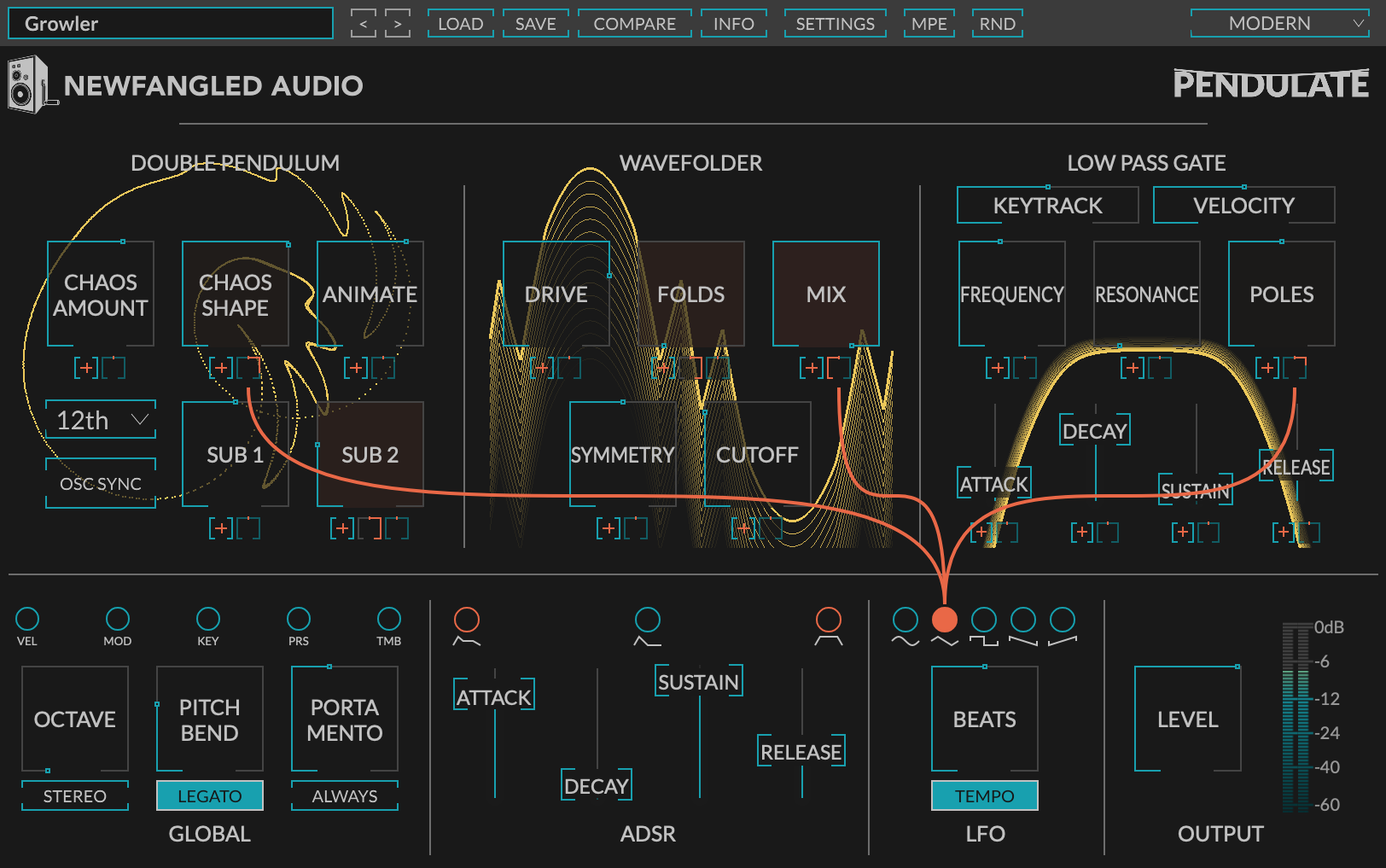
Pendulate’s modulation system is where things really get wild. Every control can be modulated directly from the main interface, with envelope, LFO, MIDI, and full MPE support all baked in.
Envelopes and LFOs generate multiple outputs simultaneously, just like a modular system, and can even modulate each other. The result is up to hundreds of modulation routings without ever opening a secondary panel.
To keep all this complexity playable, Pendulate uses clear visual feedback and real-time animations that show exactly how the oscillator, wavefolder, and gate are behaving.
Add in a modern preset browser, A/B comparison, undo history, and a fully resizable UI, and this ends up being one of the most forward-thinking free synths available today.
Key Features:
A truly chaotic oscillator based on double-pendulum physics.
- Smooth morphing from sine wave to full chaos
- Wavefolder inspired by Buchla 259
- Low pass gate inspired by Buchla 292
- Massive modulation system with single-page routing
- Envelope and LFO with multiple simultaneous outputs
- Full MPE support for expressive controllers
- Animated modules for visual feedback
- 136 presets including artist banks
- Preset browser with tags, search, and favourites
- Fully resizable UI with multiple colour themes
FAQ
Pendulate shines in experimental electronic music, techno, bass music, sound design, industrial, and anything that benefits from movement and instability.
It’s different, but not difficult. The interface and visual feedback make it surprisingly intuitive once you start experimenting
Yes. You can dial it back to smooth, musical tones, but its real strength is in evolving, animated sounds.
Not really. It complements one. Think of it as a chaos generator rather than a bread-and-butter synth.