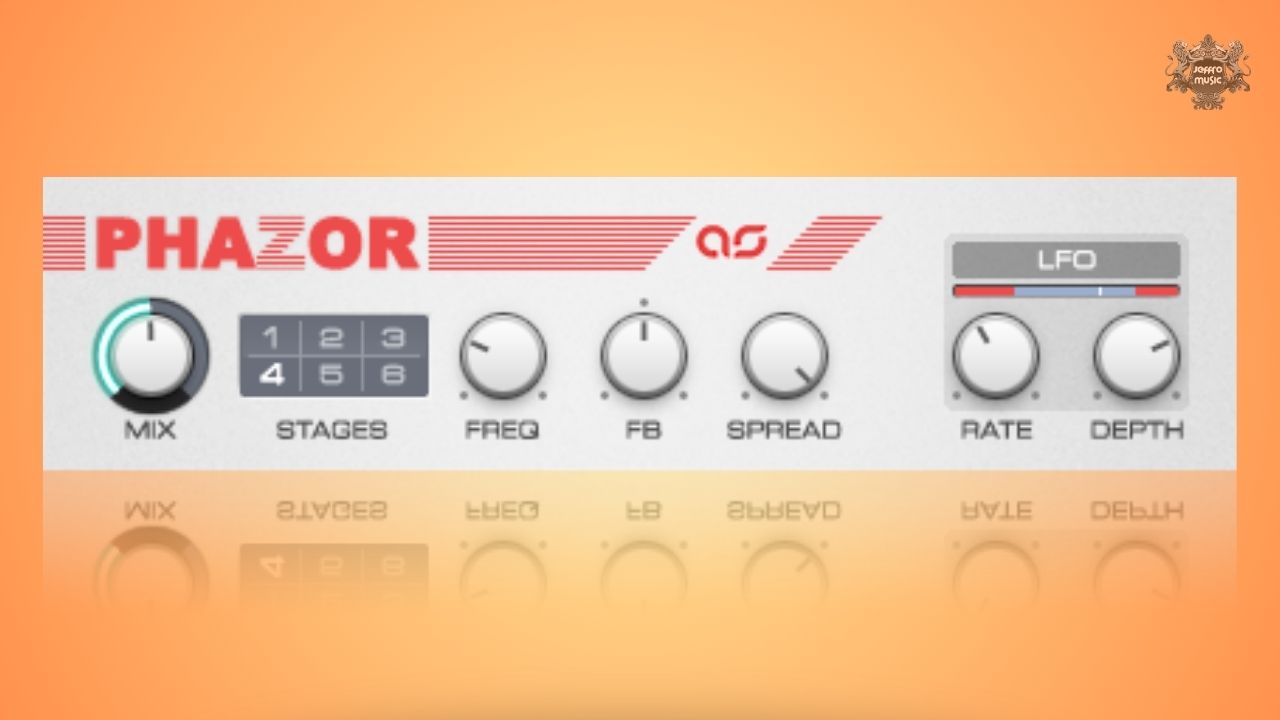
Phazor is a free phaser effect designed to faithfully recreate the distinctive phaser sound found in the Access Virus synthesizers.
That phaser played a huge role in defining the Virus’ character, and Adam Szabo has gone to great lengths to capture its movement, tone, and behaviour with remarkable accuracy.
The result is a lightweight, mix-ready phaser that delivers classic electronic modulation without the CPU overhead or complexity of modern multi-effects.
At its core, Phazor uses a chain of 1 to 6 all-pass filter stages, modulated by an internal LFO.
This allows it to move seamlessly from subtle phase shimmer to deep, swirling modulation, closely mirroring the response of the original Virus phaser.
The character remains smooth and controlled even at higher feedback settings, avoiding the brittle artefacts common in cheaper phaser designs.
The Spread control adjusts how modulation is distributed across the stereo field, adding width and depth without destabilising the centre image.
Combined with adjustable Feedback, Phazor can produce anything from gentle motion to aggressive, resonant sweeps that cut cleanly through a mix.
Phazor is deliberately efficient. The DSP is highly optimised, keeping CPU usage extremely low and making it practical to run multiple instances across a project.
This makes it particularly useful for synth-heavy productions, where phasing is often applied across several layers rather than a single sound.
The interface is clean and direct, with every control behaving exactly as expected for anyone familiar with the Virus modulation workflow.
There’s no unnecessary complexity here — just a focused modulation tool that delivers a specific, highly recognisable sound.
A faithful recreation of a classic synth phaser effect.
Each control has been tuned to match the behaviour of the original, resulting in very similar modulation depth, feedback response, and overall character.
Fewer stages produce subtle, transparent movement, while higher stage counts create deeper, more pronounced phasing with stronger notches.
Yes. While it excels on synths and pads, it can also add controlled movement to guitars, effects buses, and percussion when used carefully.
Absolutely. Its minimal CPU footprint makes it easy to deploy across multiple tracks without performance issues.