Grind Distortion
GRIND Distortion vst
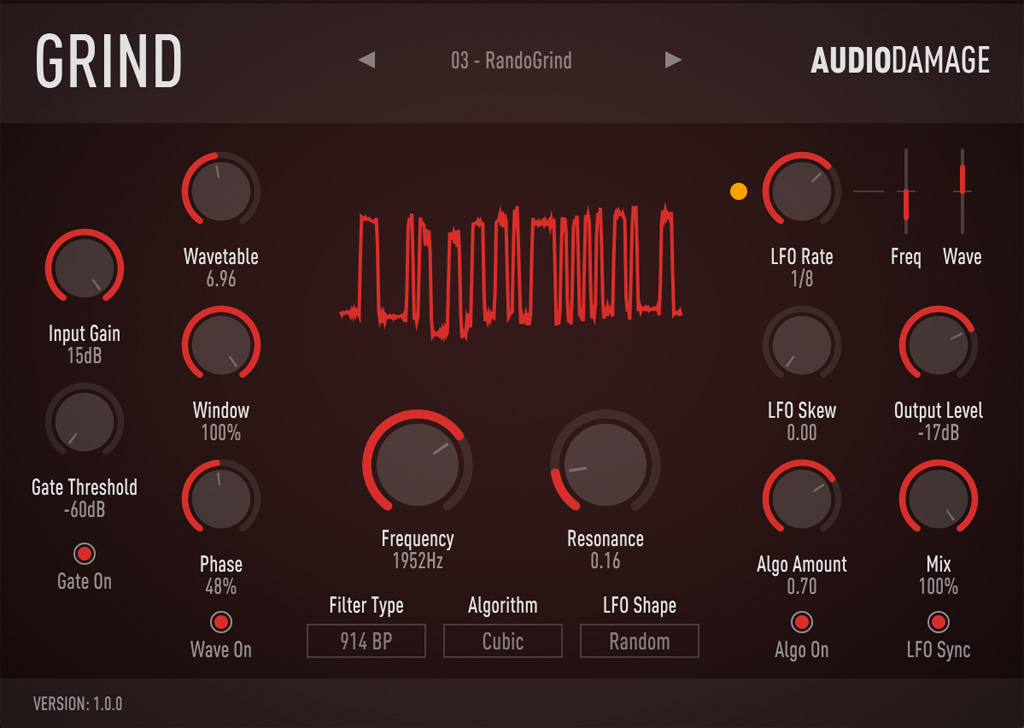
Grind is Audio Damage at its most unapologetic. Designed as a full-spectrum distortion and mangling processor, it moves far beyond conventional saturation into territory reserved for aggressive sound design and experimental processing.
From restrained tube-style warmth to full-on wavetable obliteration, Grind is less an effect and more a modular destruction chain, one that rewards producers willing to push signals to the edge and beyond.
System Requirements:
- 32-bit
- 64-bit
- VST/ AU
- Windows
- MacOs
Wavetable Mangling & Distortion Core
Grind’s signal path begins with a wavetable lookup stage, where the incoming audio’s amplitude is used to replace samples with values from one of 15 purpose-built wavetables.
These aren’t synth-style wavetables aimed at musical purity, they’re chosen specifically for their ability to break, fold, and contort audio.
Window size and phase controls further shape how aggressively the wavetable stage reacts, allowing anything from controlled digital grit to outright waveform collapse.
Following this is the algorithmic distortion module, featuring 11 saturation and distortion algorithms.
These range from soft-knee saturation and classic drive curves to extreme sine warping and nonlinear shaping.
This stage defines Grind’s core character, turning already mangled signals into harmonically dense, unstable textures that thrive on abuse.
Filtering, Modulation & Control
After distortion, the signal is routed through a multi-mode filter section with 11 different filter models. These include early “vintage digital” filter designs alongside modern analogue-modelled filters inspired by MS20-style lowpass and highpass circuits.
This makes it possible to sculpt chaos into something usable, or push it even further into noise-driven extremes. A tempo-synced LFO can modulate the filter cutoff, adding rhythmic movement or evolving instability.
The final output stage applies soft clipping and DC filtering, keeping even the most violent processing within controllable limits.
While Grind can be dialled back for filtering and saturation duties, it clearly excels when pushed hard, where its raw, aggressive personality fully comes alive.
Key Features:
Compact, musical, and built to deliver creative delay textures.
- A modular destruction chain built for aggressive sound design.
- Wavetable-based audio mangling with 15 destructive tables.
- Amplitude-driven waveform replacement.
- Window size and phase shaping controls.
- 11 distortion and saturation algorithms.
- Multi-mode filter section with 11 filter models.
- Vintage digital and analogue-modelled filter options.
FAQ
Instead of shaping harmonics mathematically, Grind replaces waveform samples using amplitude-driven wavetable lookup, producing more unpredictable and aggressive results.
It can be restrained with careful gain staging and algorithm selection, but its design clearly favours aggressive processing and extreme sound manipulation.
The filter allows post-distortion sculpting, helping focus energy, remove harsh frequencies, or exaggerate movement when combined with modulation.
Yes. It excels on synths, drums, bass, and sound effects, particularly when used as a creative sound-design processor rather than a utility effect.