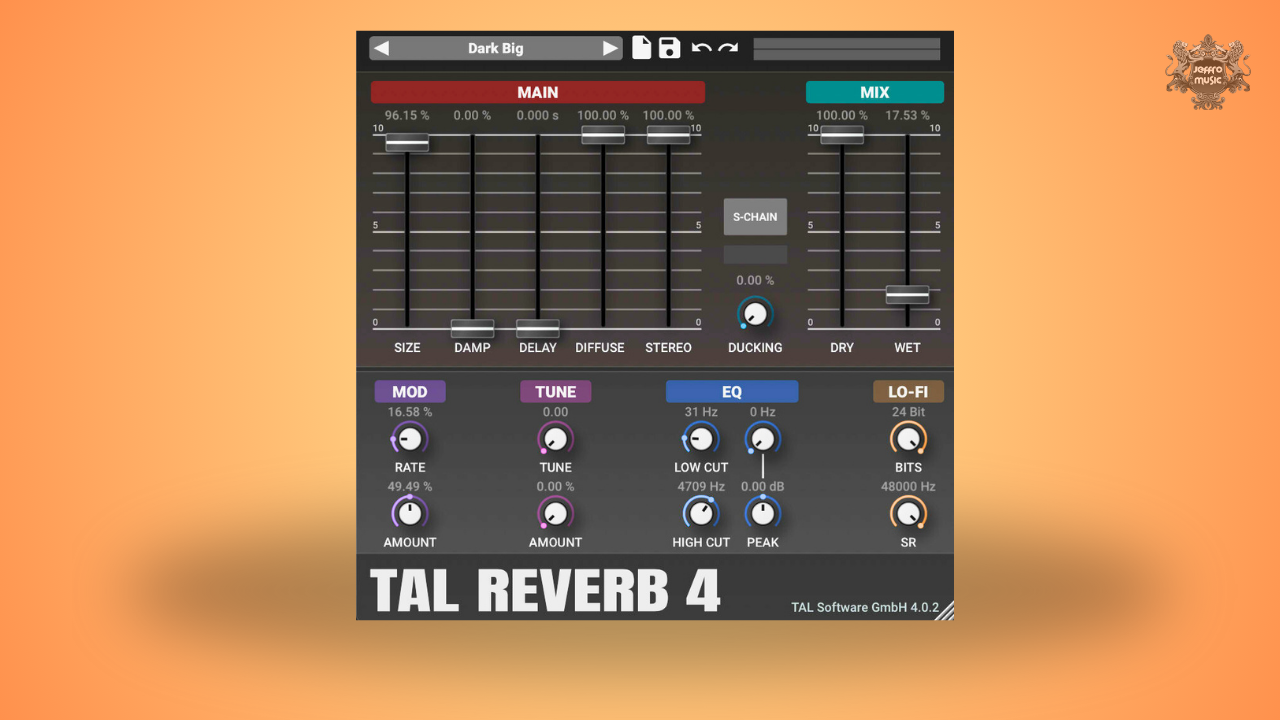
TAL Reverb 4
TAL Reverb 4
TAL-Reverb-4 is a high-quality plate reverb designed to capture the lush, modulated ambience of classic 1980s digital hardware. Rather than chasing realism or modern transparency, it leans into character, delivering dense diffusion, fast build-up, and animated tails that feel instantly musical.
It’s a reverb built to be felt rather than analysed, and a favourite for producers looking to inject vintage colour into modern mixes.
System Requirements:
- 64-bit
- VST/ AU
- Windows
- MacOs
Vintage Plate Sound & Diffusion
At the heart of TAL-Reverb-4 is a very diffuse plate algorithm with a fast attack, allowing reverb energy to bloom almost immediately after the dry signal.
This makes it especially effective on vocals, snares, synth stabs, and pads, where slower reverbs can feel detached or washy. Even at longer decay times, the reverb maintains density and cohesion without collapsing into grainy artefacts.
The modulation is key to its sound. Subtle pitch movement prevents static tails and introduces the gentle shimmer associated with early digital reverbs. This gives TAL-Reverb-4 its distinctive vintage tone — smooth, wide, and slightly animated — without turning the reverb into an obvious chorus effect.
Workflow & Musical Use
TAL-Reverb-4 is intentionally simple. With a minimal control set and no hidden complexity, it encourages fast decisions and intuitive use.
The stereo-only signal path ensures consistent width and imaging, making it easy to drop into a mix without worrying about routing or phase issues.
Its strength lies in versatility through tone rather than parameters. While rooted in plate reverb behaviour, it works across almost any source material, from drums and vocals to full synth layers.
It’s particularly effective when used as a send effect, where its dense tail can glue elements together and add depth without clutter.
Key Features:
A focused plate reverb built around tone, speed, and vintage movement.
- High-quality plate reverb with classic 80s character
- Dense, highly diffuse reverb tails
- Fast build-up time, even at long decay settings
- Simple, streamlined interface
- Works well on a wide range of audio material
- Stereo processing only
FAQ
Its combination of dense diffusion and subtle modulation recreates the movement and colour associated with early digital plate and hall reverbs from the 1980s.
The fast build-up allows reverb energy to appear quickly after the dry signal, making it feel more present and connected to the source.
Yes. Even at long decay times, the diffusion remains smooth and stable, avoiding graininess or static ringing.
The algorithm is designed around a stereo image to preserve width and consistency, rather than collapsing into mono-compatible paths.