DRAGONFLY REVERB
Dragonfly reverb
System Requirements:
Dragonfly Hall Reverb is a free stereo-to-stereo algorithmic reverb focused on realistic concert hall spaces, with the flexibility to scale down into rooms, studios, and chambers.
Built on the Hibiki Reverb architecture from Freeverb3VST, it combines Moorer-style early reflections with a modified FDN allpass Zita reverb to deliver dense, natural-sounding spaces without the instability or ringing often found in older designs.
Rather than chasing character or colour, Dragonfly Hall prioritises clarity, control, and transparency. It’s a technical reverb designed for producers who want to understand and shape space at a structural level.
- 32 -bit
- 64 -bit
- VST/ AU
- Windows
- MacOs
Early Reflections & Late Reverb Architecture
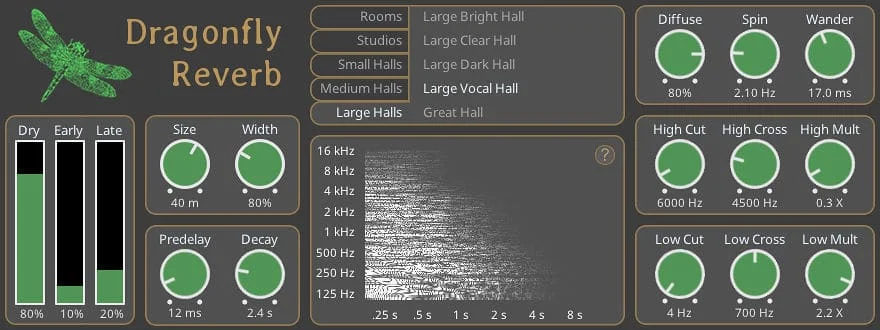
Dragonfly Hall separates early reflections and late reverberation into distinct signal paths, giving precise control over spatial perception.
Early reflections establish the sense of room size and proximity, while the late reverb tail defines depth and sustain. Independent level controls for Dry, Early, and Late signals allow fine-grained balancing without altering presets, making it easy to audition spaces while keeping gain staging consistent.
The reverb size parameter directly affects the internal delay line lengths, influencing reflection density and attack behaviour.
Smaller sizes increase echo density and immediacy, while larger sizes reduce density and create smoother, slower-building tails. This makes Dragonfly Hall particularly effective on orchestral material, acoustic instruments, and spatial sound design where realism matters.
Advanced Diffusion, Modulation & Spectral Control
The late reverb engine uses adjustable allpass diffusion, allowing users to trade echo density against colouration.
Low diffusion exposes discrete reflections and granular texture, while higher diffusion produces smooth, lush tails at the risk of metallic resonance depending on material. This balance is crucial for tailoring the reverb to percussive versus sustained sources.
Modulation is applied exclusively to the late reverberation and controlled via Modulation, Spin, and Wander parameters. Spin determines modulation rate, while Wander spreads modulation layers across the stereo field, preventing static or phase-locked tails.
Together, they allow anything from subtle stereo movement to wide, evolving ambience.
Frequency-dependent decay is handled through high and low crossover points with multipliers, enabling different decay times across the spectrum.
This makes it possible to keep high frequencies controlled while allowing low-end energy to bloom, or vice versa, without resorting to external EQ.
Key Features:
A deeply controllable hall reverb rooted in classic algorithmic design.
- Moorer early reflection model with modified FDN allpass reverb
- Independent early reflection and late reverb processing
- True stereo signal path
- Adjustable reverb size with physical space correlation
- Advanced diffusion control for echo density shaping
- Frequency-dependent decay via high/low crossovers and multipliers
FAQ
The combination of time-variant processing, controlled diffusion, and frequency-dependent decay helps suppress static resonances while maintaining density.
Early Send determines how much early reflection energy feeds into the late reverb engine, while Early Level controls how much early reflection signal is heard at the output. This separation allows precise spatial tuning.
Lower diffusion exposes discrete reflections and can sound aggressive on transients. For drums and percussion, moderate diffusion usually balances clarity with smoothness.
Spin controls modulation rate globally, while Wander offsets modulation layers spatially, preventing phase-locked movement and creating a more natural stereo field.
Video