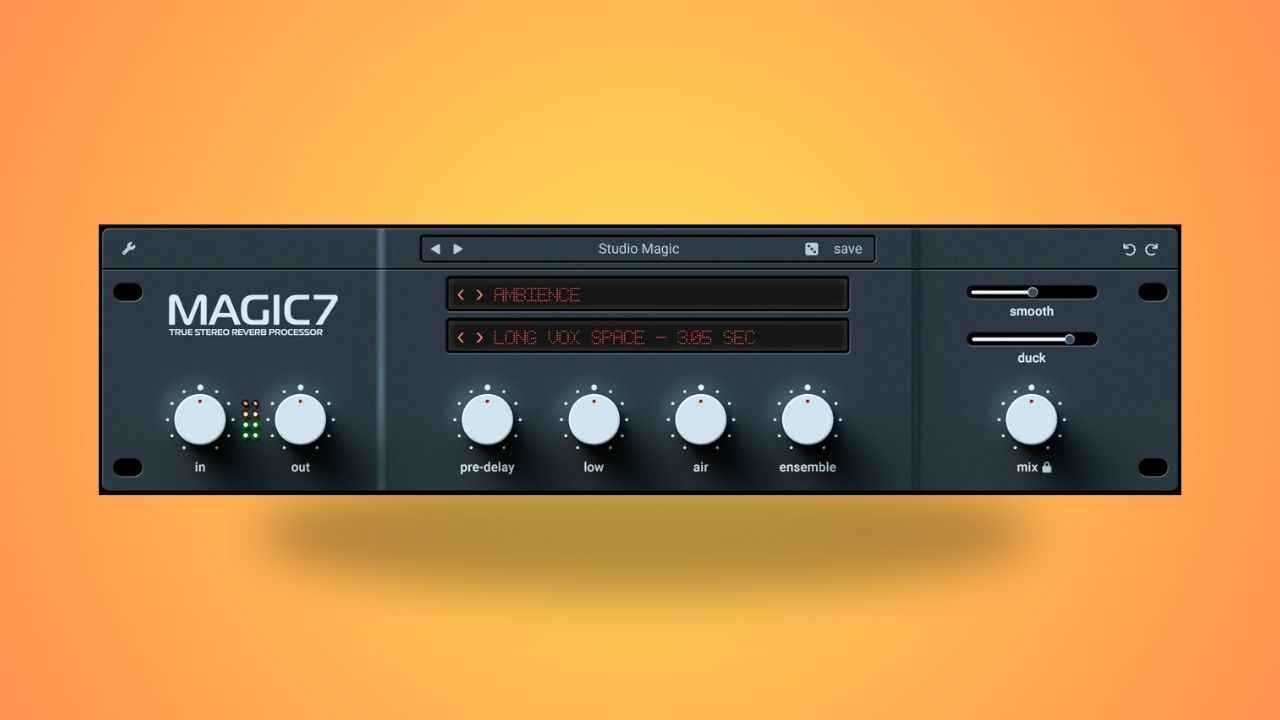
MAGIC7 REVERB
magic7
System Requirements:
Magic7 is a free reverb plugin built around one of the most revered digital reverbs ever made: the Bricasti M7. Long trusted by top-tier mix and mastering engineers for its realism and depth, the M7 has become a benchmark for natural spatial processing. Magic7 brings that unmistakable sound into the box, offering a streamlined but powerful reverb that delivers three-dimensional depth across drums, vocals, synths, and full mixes without the usual compromises of free plugins.
- 64-bit
- VST/ AU
- Windows
- MacOs
Immersive M7 Reverb Engine
At its core, Magic7 delivers all 234 original M7 presets, captured and presented in true stereo. These presets span an enormous range of spaces, from tight ambiences and focused drum rooms to expansive halls, warm chambers, plates, nonlinear spaces, and vast cinematic environments. The reverb tails are dense, smooth, and highly detailed, preserving clarity even at longer decay times.
Rather than emulating a single room type, Magic7 offers 11 distinct reverb algorithms, each reflecting a different spatial character of the original hardware. This makes it equally suited to subtle mix enhancement and bold spatial design, whether you need depth that disappears into the track or reverbs that define the entire atmosphere.
Modern Control & Tonal Shaping
Magic7 extends beyond static preset playback with a set of modern production tools designed for real-world mixing. Tempo-synced pre-delay allows the reverb to sit rhythmically within a track, while dedicated low and air EQ bands shape the tonal balance of the tail without affecting the dry signal.
Built-in reverb ducking helps maintain clarity, particularly on vocals and drums, by dynamically reducing the reverb level during transients.
Two modulation modes expand the spatial character further. Flux introduces subtle, natural movement for added realism, while Ensemble adds a richer, chorus-style modulation that enhances width and warmth.
The Smooth control addresses transient harshness by gently reducing initial attack energy before it enters the reverb, resulting in thicker, more musical decay without dulling the source.
Key Features:
A World-Class Digital Reverb engine rebuilt for modern workflows.
- Authentic recreation of the legendary Bricasti M7 reverb
- 234 factory presets delivered in true stereo
- 11 reverb types including Ambience, Rooms, Plates, Halls, Spaces, and Nonlinear
- Tempo-sync pre-delay for rhythmic placement
- Reverb ducking for improved mix clarity
- Low and air EQ bands for precise tonal shaping
FAQ
Each channel is processed independently with unique reflection paths, preserving spatial cues and depth rather than collapsing the reverb into a pseudo-stereo image
Flux applies subtle, low-depth modulation to maintain realism and movement, while Ensemble introduces more pronounced pitch variation for wider, warmer, chorus-like reverb tails.
Yes. Its clean decay, stable stereo image, and controlled modulation make it suitable for gentle spatial enhancement on buses or full mixes when used conservatively.
Smooth only affects the signal entering the reverb engine, reducing transient sharpness in the reverb tail without altering the dry sound or overall punch.